

There’s a quiet kind of fear that comes with this.
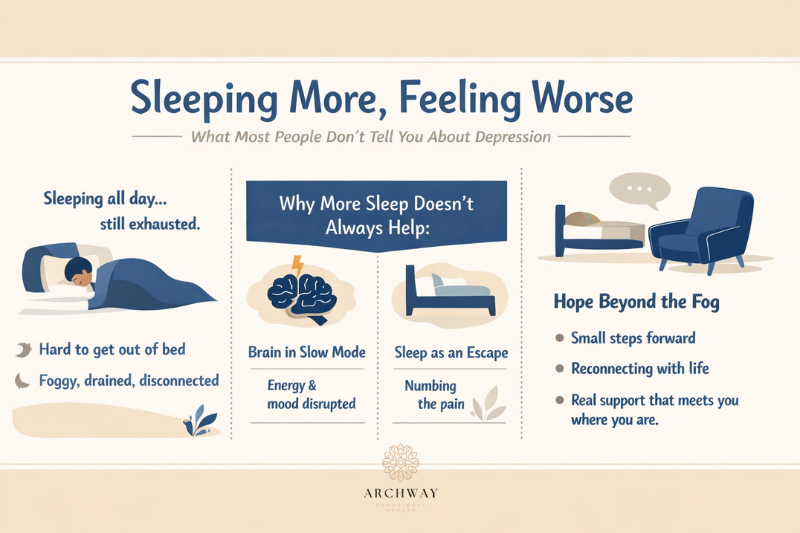
You’re sleeping longer than usual—sometimes 10, 12, even 14 hours—and still waking up heavy, foggy, and drained.
If that’s where you are right now, you’re not imagining it. And you’re not alone.
If you’ve already started wondering whether something deeper is going on, you can explore our depression treatment program services to understand what real support can look like.
The Myth That Rest Always Fixes Everything
We’re taught that sleep is the answer.
Tired? Sleep more. Burned out? Rest.
But depression doesn’t follow that rule.
Sometimes, sleep becomes less like rest… and more like escape.
A place where your mind gets a break, but your body never really resets.
And the confusing part? The more you sleep, the harder it can feel to get up.
What It Feels Like (That No One Really Explains)
People often expect depression to look like sadness.
But for many, it feels more like this:
🚩 You might recognize this if:
- You wake up already exhausted
- Getting out of bed feels physically heavy, not just mentally hard
- Naps don’t refresh you—they just blur the day
- You cancel plans because staying in bed feels safer
- Time starts slipping away without you noticing
It’s not laziness.
It’s not a lack of discipline.
It’s your system slowing down in ways you didn’t choose.
Why Oversleeping Can Be Part of Depression
There’s a reason this happens—and it’s not a personal failure.
Depression can disrupt the brain’s regulation of sleep, energy, and motivation.
So instead of sleep restoring you, it can deepen the fog.
Some people experience insomnia.
Others experience the opposite—sleeping too much depression patterns that feel impossible to break.
Both come from the same place: your brain trying to cope.
The Part People Don’t Say Out Loud
Here’s something many people don’t admit at first:
Sleeping can start to feel like the only relief.
Not because you want to disappear—but because being awake feels like too much effort. Too much noise. Too much pressure to function.
We’ve heard this from people sitting exactly where you are:
“I wasn’t trying to give up. I just didn’t have anything left to give.”
That space—right there—is often where treatment begins.
What Starting Treatment Is Actually Like
There’s a lot of fear around getting help.
Especially if this is your first time.
You might be thinking:
- What if it doesn’t work?
- What if I can’t keep up?
- What if they expect too much from me?
The reality is much quieter than that.
Treatment doesn’t ask you to suddenly become a different person.
It helps you slowly reconnect with the version of yourself that feels buried right now.
Some people start with structured daytime care.
Others need more consistent, multi-day weekly support.
If there are overlapping challenges—like mood changes mixed with other mental health symptoms—getting the right kind of support in treatment in Boca Raton can make things feel less confusing and more manageable.
Small Shifts That Start to Matter
Recovery doesn’t usually look dramatic at first.
It looks like:
- Waking up and staying awake a little longer
- Feeling one moment of clarity during the day
- Having a conversation that doesn’t drain you completely
These are small things.
But they’re not small progress.
They’re signs your system is starting to come back online.
You Don’t Have to Keep Guessing
If you’re stuck in this loop—sleeping more, feeling worse, wondering why—it makes sense that you’d feel confused or even scared.
But you don’t have to figure it out alone.
There is a path forward that doesn’t rely on willpower or pushing through exhaustion.
There is support that meets you exactly where you are.
Call (888) 488-4103 or visit our depression treatment program services in to learn more about how we can help you start feeling like yourself again.
And if no one’s told you this yet:
Needing help doesn’t mean you’ve failed. It usually means you’ve been carrying too much for too long.
