

By the time the day winds down, most people expect relief. Quiet. Maybe even a sense of closure.
But for some, 5PM is when everything starts to unravel.
If you’ve ever found yourself searching for answers late in the day—wondering why the panic hits harder at night—you’re not alone. And if you’ve tried treatment before and felt like it didn’t help, it makes sense you’d hesitate to try again.
Still, something brought you here. That matters.
If you’re looking for real, consistent anxiety treatment in Boca Raton, especially when symptoms don’t follow a 9–5 schedule, there are options that meet you where you are—not where programs expect you to be.
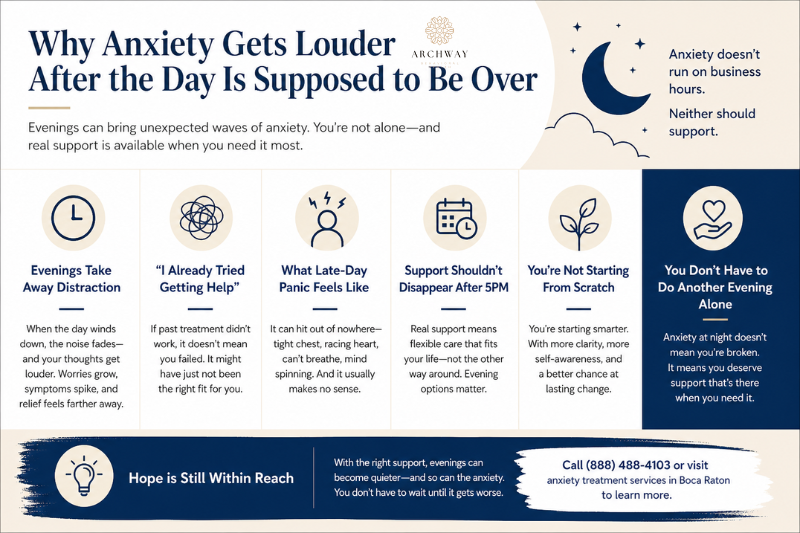
Evenings Don’t Distract You the Way Days Do
During the day, there’s structure. Emails. Conversations. Tasks.
At night, it’s just you and your thoughts.
That’s often when anxiety fills the silence. Small worries get louder. Physical symptoms creep in—tight chest, racing heart, that familiar sense that something isn’t right.
It’s not random. It’s what happens when the noise fades and your nervous system finally catches up.
“I Already Tried Getting Help”—And It Didn’t Stick
We hear this more than you might think.
People come in frustrated. Not because they didn’t try—but because what they tried didn’t feel built for them.
Maybe the schedule didn’t work.
Maybe the support felt surface-level.
Maybe it helped for a while… and then didn’t.
That doesn’t mean treatment doesn’t work. It means the fit wasn’t right.
There’s a difference.
What Late-Day Panic Actually Feels Like
It’s not always dramatic.
Sometimes it’s subtle at first—like something shifting inside your body before your mind catches up.
Other times, it’s immediate and overwhelming.
“I was fine all day. Then I got home, sat down, and suddenly I couldn’t breathe. It didn’t make sense.”
That confusion is part of what makes it so unsettling.
And it’s why so many people end up searching for panic attack help near me late at night, hoping someone is still open, still listening.
Support Shouldn’t Disappear After 5PM
Here’s the part that needs to change: anxiety doesn’t run on business hours.
So treatment shouldn’t either.
Real support means flexibility. It means having access to care when symptoms actually show up—not just when it’s convenient on a calendar.
That might look like structured evening sessions, or care that adjusts to your rhythm instead of forcing you into one.
For some people, anxiety is also tied to deeper patterns—especially when mental health challenges overlap with other conditions. In those cases, finding the right kind of integrated care, like support in Dual Diagnosis, can make a difference where past treatment didn’t.
You’re Not Starting From Scratch—You’re Starting Smarter
Trying again doesn’t mean repeating the same experience.
It means coming in with more awareness. More clarity about what didn’t work.
And that’s actually a strength.
We’ve worked with people who felt exactly where you might be right now—skeptical, tired of trying, unsure if anything will feel different.
Some of them didn’t believe it would.
But they stayed long enough to notice small shifts.
Then slightly bigger ones.
Then something steadier.
Not overnight. But real.
The Quiet Truth About Anxiety at Night
Here’s the part people don’t say enough:
Nighttime anxiety doesn’t mean you’re broken.
It means something in your system is asking for attention—just at a time when it’s hardest to manage alone.
And no, it doesn’t always go away on its own.
But it can become manageable. Predictable. Even quiet.
With the right kind of support.
You Don’t Have to White-Knuckle Another Evening
If evenings have started to feel like something you have to survive, that’s worth paying attention to.
You don’t have to wait until it gets worse.
You don’t have to prove how bad it is before getting help.
You just have to take one step that feels different from the last time.
Call (888) 488-4103 or visit our anxiety treatment services in Boca Raton to learn more about what support can actually look like now.
