

Some people wake up feeling fine, get frustrated by a text message at lunch, and spend the rest of the day emotionally wrecked.
Others find themselves saying things they don’t mean in the heat of the moment, only to replay the conversation for hours afterward with a knot in their stomach.
If that sounds familiar, you’re not broken. You’re not dramatic. And you’re not the only person wondering why your emotions seem to go from zero to one hundred before you even realize what’s happening.
At Archway Behavioral Health, we often meet people who feel trapped in these cycles. While this experience can be connected to many underlying factors, learning how emotions work is often the first step toward regaining a sense of control. Many people find support through approaches like DBT therapy, which teaches practical skills for navigating overwhelming emotions without being controlled by them.
Notice What Happens Before the Explosion
Emotional whiplash rarely appears out of nowhere.
Most emotional reactions have a buildup phase that happens so quickly we miss it. A stressful email. A critical comment. A canceled plan. A feeling of rejection that lands harder than expected.
The emotion itself may feel instant, but there is often a chain reaction underneath it.
Think of it like a smoke alarm that’s become extra sensitive. Toast burns in the kitchen and suddenly the entire house is screaming. The alarm isn’t wrong. It’s just reacting with more intensity than the situation requires.
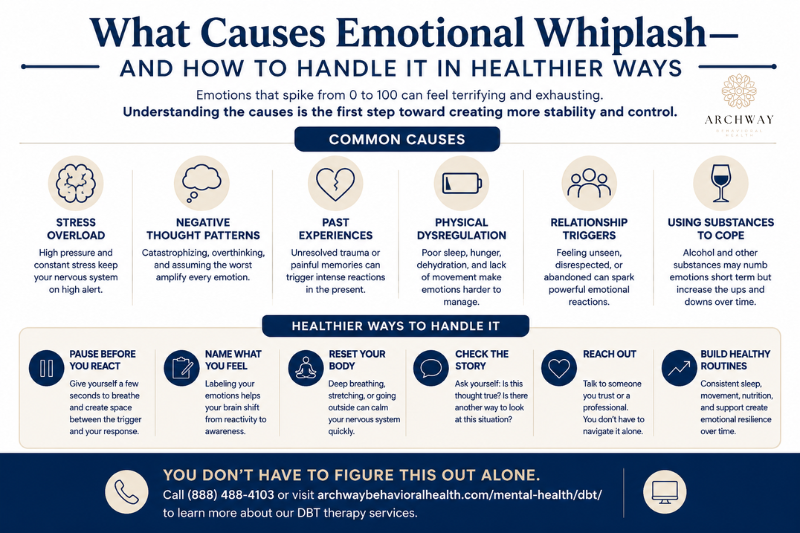
Many people who struggle with emotional dysregulation in adults describe feeling blindsided by their own reactions. The goal isn’t to eliminate emotions. It’s learning to spot the spark before it becomes a wildfire.
Stop Treating Every Feeling Like a Fact
One of the most common mistakes people make is assuming that because they feel something intensely, it must be true.
If you feel rejected, you may conclude someone doesn’t care about you.
If you feel ashamed, you may decide you’ve ruined everything.
If you feel angry, you may believe someone intentionally hurt you.
Emotions provide information, but they don’t always provide accurate conclusions.
A healthier response is asking:
- What am I feeling right now?
- What triggered it?
- What evidence supports the story I’m telling myself?
- Is there another explanation?
This pause creates space between the feeling and the reaction.
That space is where better decisions happen.
Give Your Nervous System Time to Catch Up
Strong emotions activate survival responses.
Your brain becomes focused on protection rather than perspective. That’s why people often send texts they regret, end relationships impulsively, or say things they never would have said an hour later.
When emotions spike, try delaying major decisions.
Take a walk.
Drink water.
Step away from the conversation.
Set a timer for twenty minutes before responding.
These aren’t avoidance tactics. They’re nervous system regulation strategies.
A calmer brain usually tells a more complete story.
Learn the Difference Between Relief and Resolution
Many behaviors that temporarily reduce emotional pain don’t actually solve the problem.
Scrolling endlessly.
Drinking to relax.
Starting an argument.
Ghosting someone.
Shutting down emotionally.
These actions may create short-term relief while making long-term distress worse.
One reason people exploring sobriety often become more aware of emotional swings is because alcohol and other substances can temporarily mute difficult feelings. Without that buffer, emotions become more noticeable.
That awareness can feel uncomfortable at first. It can also become an opportunity.
Instead of escaping the feeling, try identifying what the feeling is asking for.
Anger may need a boundary.
Sadness may need support.
Anxiety may need reassurance or action.
The emotion isn’t the enemy. The reaction sometimes is.
Build a Personal Reset Routine
People often wait until they’re overwhelmed before trying to regulate themselves.
That’s like looking for a life jacket after you’ve fallen overboard.
Create a reset routine before you need it.
Quick Emotional Reset Ideas
- Take five slow breaths with a longer exhale than inhale
- Write down exactly what you’re feeling
- Go outside for ten minutes
- Listen to calming music
- Text someone you trust
- Stretch or move your body
- Delay difficult conversations until you’re regulated
These small actions may seem simple, but consistency matters more than complexity.
The goal is not perfection. The goal is shortening the distance between being triggered and finding your footing again.
Know When the Pattern Is Bigger Than Stress
Everyone experiences emotional ups and downs.
But if intense emotional reactions are affecting relationships, work, self-esteem, or your ability to function, it may be time to look deeper.
You might notice:
- Frequent regret after arguments
- Rapid shifts between emotional highs and lows
- Feeling emotionally exhausted most days
- Difficulty calming down once upset
- Using alcohol or other coping behaviors to escape emotions
In some cases, emotional instability may be connected to underlying mental health conditions, trauma, or situations where mental health and substance use overlap. For individuals facing both challenges, finding specialized support in Dual Diagnosis can provide a more complete path forward.
Seeking help isn’t admitting defeat.
It’s recognizing that emotions deserve tools, not just endurance.
The Goal Isn’t to Feel Less
Many people start searching for answers because they’re tired of feeling too much.
But the real goal isn’t becoming numb.
It’s learning how to experience emotions without being thrown around by them.
You can feel anger without destroying a relationship.
You can feel sadness without drowning in it.
You can feel anxiety without letting it make every decision for you.
That kind of emotional flexibility is a skill. And like any skill, it can be learned.
If emotional whiplash has become a recurring part of your life, support is available. Call (888) 488-4103 or visit our DBT therapy services to learn more about our DBT therapy services. Whether you’re exploring healthier coping strategies, questioning your relationship with alcohol, or simply tired of feeling controlled by intense emotions, our team is here to help.
