

You don’t need a perfect explanation to come back.
You just need a moment where you’re honest enough to try again.
If you’ve found yourself searching for something like an outpatient depression program near me, there’s a good chance a part of you already knows—you weren’t done. You just paused.
And that’s allowed.
Early on, if you’re even considering returning, it might help to revisit what structured support can look like through an intensive outpatient program—not as a commitment, just as a reminder of what’s there.
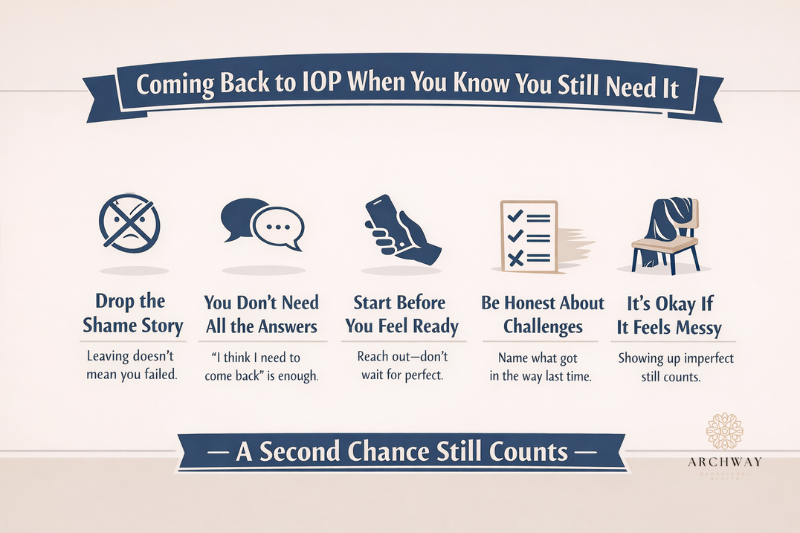
Start by Dropping the “I Messed This Up” Story
Most people don’t leave because they’re lazy or don’t care.
They leave because something got hard.
Maybe it was showing up every day.
Maybe something personal hit.
Maybe you just didn’t feel ready to be seen that clearly.
Leaving doesn’t mean you failed. It means something overwhelmed your system.
Coming back isn’t starting over from zero.
It’s picking up from a place where you already know more than you did before.
You Don’t Have to Explain Everything
That voice in your head might be saying:
“They’re going to ask where you’ve been.”
“They’ll be disappointed.”
“They won’t take you seriously.”
Here’s the truth: most programs expect this.
People step away. People ghost. People come back.
You don’t need a speech.
You don’t need a perfectly worded apology.
A simple, “Hey, I think I need to come back,” is enough.
Reach Out Before You Feel Fully Ready
Waiting until you feel 100% ready is one of the biggest traps.
Because readiness isn’t a switch—it’s a moving target.
You might feel unsure, embarrassed, or even resistant.
That doesn’t mean you shouldn’t reach out.
It usually means you’re right on the edge of something important.
Send the message. Make the call. Even if your voice shakes a little.
Expect It to Feel Different This Time
Coming back isn’t a rewind. It’s a second look.
You’ll notice things you didn’t before.
You might hear something land differently.
You might be more honest—or more guarded.
All of that is okay.
Sometimes the second attempt is where things actually start to click—not because the program changed, but because something in you softened just enough to let it in.
Be Honest About What Didn’t Work Last Time
This part matters—but it doesn’t have to be dramatic.
Ask yourself:
- Was the schedule too much?
- Did I shut down in groups?
- Did I avoid opening up?
- Was I overwhelmed outside of treatment?
You don’t need to fix everything.
You just need to name one or two things that got in the way.
That’s how the next version of this can actually fit you better.
Let It Be Messy—It Still Counts
Coming back doesn’t have to look strong or confident.
It can look like:
- Logging in late
- Sitting quietly at first
- Not knowing what to say
- Feeling like you don’t belong (again)
None of that disqualifies you.
Progress doesn’t always look like forward motion.
Sometimes it looks like returning to the same place—but with a little more honesty.
You’re Not the Only One Doing This
There’s this quiet assumption that everyone else “sticks it out” and you’re the only one who couldn’t.
That’s not real.
A lot of people step away.
A lot of people come back.
Some of the strongest recoveries are built on multiple attempts—not because people are weak, but because they kept choosing not to give up on themselves.
If Mental Health Feels More Complicated Than Just One Thing
Sometimes what made it hard to stay before wasn’t just depression.
It might have been anxiety, mood swings, or something harder to name.
For some people, it’s the overlap—when mental health symptoms start layering together. That’s where more integrated support, like care in Dual Diagnosis, can make things feel more manageable instead of overwhelming.
You don’t have to figure that out alone this time.
One Small Step Is Enough
You don’t need to commit to the whole process today.
You don’t need to promise you’ll finish.
Just take one step back toward support.
Even thinking about returning means something in you still wants help.
That part of you is worth listening to.
If you’re considering coming back, you’re not starting over—you’re continuing something that mattered.
Call (888) 488-4103 or visit our intensive outpatient program services to learn more about your options for care in Dual Diagnosis.
