

You’ve probably replayed every conversation in your head. Wondered what you missed. Questioned whether you should be doing more—or less.
And somewhere in the quiet moments, a question keeps surfacing: Why does everything still feel so heavy for them… and for me?
If you’ve found yourself searching things like why do i feel empty, you’re not alone—and neither is your child.
This Isn’t Something You Caused
Parents often carry a silent weight: “If I had done something differently, would they be okay?”
Depression doesn’t work like that.
It’s not a parenting failure. It’s not a lack of love. And it’s not something that can always be reached through conversations at the kitchen table—no matter how heartfelt they are.
Sometimes, what your child is experiencing runs deeper than what home alone can hold.
When Love Starts to Feel Like It’s Not Enough
You’ve shown up. You’ve listened. You’ve stayed patient longer than you thought you could.
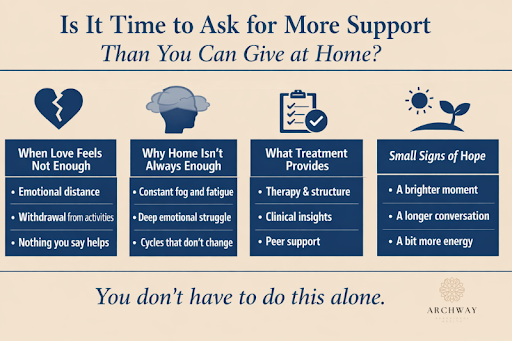
But maybe you’re noticing things like:
- They seem emotionally flat or disconnected
- Simple tasks feel overwhelming to them
- They pull away, even when you’re trying to get closer
- Nothing you say seems to land anymore
This is the moment many parents don’t talk about—the one where love is still strong, but it no longer feels like enough to create change.
That doesn’t mean you’ve failed.
It means the situation may need more support than one person—or one home—can provide.
Why Depression Can’t Always Be “Fixed” at Home
Depression isn’t just sadness. It can affect how someone thinks, feels, and even experiences reality.
Imagine trying to guide someone out of a fog… while they can’t see clearly enough to follow directions.
That’s often what it’s like.
Treatment programs exist not because families aren’t trying hard enough—but because structured, consistent care creates something home environments can’t always replicate:
- Daily therapeutic support
- Clinical insight into patterns and symptoms
- A space separate from family dynamics
- Peer connection with others who understand
Sometimes, distance from home isn’t about separation—it’s about giving healing room to begin.
What Structured Support Actually Looks Like
Not all treatment means being “sent away.”
There are different levels of care that meet people where they are, such as:
- Structured daytime care with therapy multiple days a week
- Multi-day weekly treatment that allows for gradual progress
- Round-the-clock support when symptoms feel unmanageable
For some individuals, especially when mental health challenges overlap with other struggles, specialized options like care in Dual Diagnosis can address both at the same time—because rarely is it just one thing.
A Story You May Recognize
A parent once shared this quietly:
“I kept thinking if I just said the right thing, I could reach her. But every conversation felt like it disappeared into the same silence.”
Their child eventually entered a structured program.
Not overnight—but slowly—things shifted.
They started speaking more. Eating regularly. Engaging again.
It wasn’t a miracle. It was consistency, support, and space.
And most importantly, it wasn’t something the parent had to carry alone anymore.
Letting Go of the Idea That You Have to Do This Alone
There’s a quiet kind of courage in recognizing your limits.
Not because you’re giving up—but because you’re choosing something bigger than control.
Support doesn’t replace your role as a parent.
It strengthens it.
And for many families, it becomes the turning point—not because everything is suddenly fixed, but because the weight is finally shared.
What Hope Can Look Like From Here
Hope doesn’t always arrive as a big moment.
Sometimes it looks like:
- A small shift in energy
- A conversation that goes a little deeper
- A day that feels slightly more manageable
Treatment creates the conditions for those moments to happen more often.
And over time, those small changes start to add up.
You don’t have to wait until things feel unbearable to explore support.
Call (888) 488-4103 or visit our depression treatment program services to learn more about options that can support both you and your child during this time.
And if no one has told you this recently—you’re doing more than you think. You’re still here. Still trying. That matters more than you know.
