
Clinically reviewed by Victoria Passarelli, LMHC, Clinical Director, Archway Behavioral Health
Anxiety in teenagers has a recognizable image: wringing their hands before a test, worrying out loud about what might go wrong, or appearing visibly nervous in social situations. That version exists. It’s also the least likely to get missed. Other manifestations of anxiety in teens hide, and if no one looks out for them, the teen may not get the help they need.
What gets missed? The teenager who is chronically irritable–no one connects it to anxiety, even though it’s one of the most common symptoms. The one who quits every activity they start, whose parents have started to wonder if they’re just lazy. The one who comes home and goes straight to their room every day, whose parents assume it’s a normal teenage need for space. Or the one with persistent stomachaches that have been medically investigated twice and found to be nothing.
The signs of anxiety that parents most often miss aren’t subtle. They’re just not the stereotype of what anxiety is “supposed” to look like. Here are the signs of anxiety in teenagers that parents miss and what to do if they sound familiar to your family.
Irritability and Anger
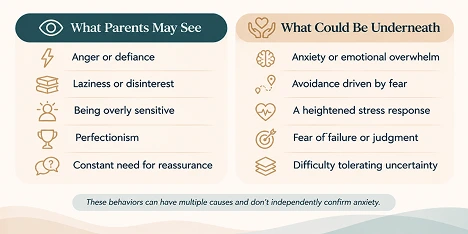
Anxiety activates the nervous system’s threat-response, which, in teenagers–with their more reactive amygdala and less regulated prefrontal cortex–often comes out as aggression rather than worry. A teen who is frequently irritable, who snaps when asked to do things that trigger anxiety, or who has meltdowns before school or social events, may be anxious rather than oppositional.
This is one of the most consistently missed presentations of teen anxiety. It can be true of any gender, but it’s particularly common in boys. The clinical picture looks like defiance. The underlying driver is fear. The behavioral response (snapping, withdrawing, refusing) is avoidance, not attitude.
“My child was nearly a straight A student. Then, they started getting mostly F’s. They said they didn’t care about school and got defensive when I asked – it turns out that it was generalized anxiety disorder.”
Avoidance That Looks Like Disinterest
Avoidance is a core behavioral feature of anxiety. When something feels threatening, the nervous system’s most effective short-term solution is to remove contact with the threat. Teenagers do this by quitting teams and clubs, declining invitations, avoiding cafeterias and hallways, or not turning in assignments they’re worried aren’t “good enough.”
Over time, this avoidance calcifies. Each avoided situation reduces the anxiety temporarily, which reinforces the avoidance, then making the avoided situation feel more threatening the next time it comes up. A teenager who was dropped off at a party and had a panic attack two years ago may now refuse to attend any social event–and their parents may have stopped noticing because the refusal became the new normal.
To a parent, this looks like a teenager who seems unmotivated, uninterested, and disengaged. What is it really? It’s a teenager whose world has gotten smaller and smaller because anxiety has been making decisions about what’s safe.
Physical Complaints With No Medical Explanation
Anxiety produces real physical symptoms through the activation of the stress response – elevated cortisol, heightened nervous system arousal, gastrointestinal sensitivity, muscle tension. Headaches, stomachaches, nausea before school, and/or fatigue that isn’t explained by sleep disruption are physiological responses to chronic anxiety, not exaggerations.
They’re also one of the most reliable indicators that anxiety is present and being missed. A teenager who has had three doctor’s appointments in four months for recurring stomachaches that resolve on school-free days is likely anxious, not physically unwell. Timing is often the tell. Take note of when your teen has these symptoms. Is it right after an anxiety trigger? Especially if medical causes have been ruled out, you’re probably on the right path if you’re thinking it could be anxiety.
If a teen has panic attacks, they might have a sudden onset of physical and mental symptoms, like sweating, shaking, trembling, chest pain or tightness, and an inability to think clearly. Panic attacks that happen more than once, or fear of future panic attacks after the first, are a sign that your teen should get screened for panic disorder. Learn more about anxiety vs. panic attacks here.
Perfectionism and Over-Preparation
A teenager who redoes their essay four times before turning it in, stays up until midnight reviewing notes for a quiz they’ll probably ace, or refuses to start assignments until the conditions are exactly right – often, this teen is described by parents as conscientious or high-achieving. They may be both. They might also be anxious.
Perfectionism is anxiety’s academic “face.” The underlying fear–of failure, of judgment, or of not being enough–drives behavior that looks like diligence from the outside. The cost is the internal experience: a teenager who can never feel like they’ve done enough, who doesn’t experience satisfaction when they succeed because the relief is immediately replaced by worry about the next thing.
Reassurance-Seeking
A teenager who repeatedly asks, “Do you think I’ll be okay?” “What if something goes wrong?” “Can you check this before I send it?” is seeking reassurance to temporarily reduce anxiety. Parents usually provide it because it works, and because it feels like supporting their child.
The problem is that reassurance reliably makes anxiety worse over time. Each reassured worry teaches the brain that the worry was legitimate and required intervention. The anxiety starts to need more reassurance to get to the same level of relief, and the situations that trigger it expand. A teenager who needed reassurance about one test eventually needs it for every assignment, then for friendships, and then for events weeks in the future.
Recognizing this pattern for what it is–an anxiety cycle, not a parenting deficit–is the first step toward responding differently.
Sleep Problems That Aren’t Just About Screen Time
Do you have a teenager who can’t fall asleep because their mind won’t stop, who lies awake replaying the day or worrying about tomorrow, or whose racing thoughts keep them up past midnight? This is anxiety’s nighttime presentation. People often blame phone use and try screen-time restrictions that don’t help because the problem isn’t the phone.
Difficulty falling asleep due to racing thoughts, combined with waking in the early morning and being unable to return to sleep, is a recognizable anxiety pattern. It compounds quickly. Sleep deprivation worsens anxiety, which worsens sleep, and so on, creating a cycle that’s hard to interrupt without clinical support.
When These Signs Mean More Than Normal Teen Stress
Stress and anxiety aren’t the same thing. Stress is a response to a real, present demand, like an upcoming exam, a conflict with a friend, or a performance. It resolves when the demand does. Anxiety persists beyond the stressor, anticipates threats that haven’t materialized, and shapes behavior in ways that limit functioning.
What’s the clinical threshold? Six or more weeks of symptoms that meaningfully affect daily life (e.g., school attendance, social functioning, sleep, family relationships). If your teenager shows several of these signs consistently for weeks, and their world seems to be getting smaller rather than larger, that’s a pattern worth taking seriously. This is the part of anxiety that makes parents feel most helpless: not knowing what to do next.
If any of this sounds familiar, start with the pediatrician for an initial screening and to rule out physical causes. If anxiety is confirmed or strongly suspected, a referral to a behavioral health program is appropriate.
Archway’s adolescent treatment program in Boca Raton treats anxiety in teenagers ages 11-17 through PHP and IOP, both in-person and virtual. The admissions team can help assess whether a structured program is the right level of care. Call (888) 488-4103 to have that conversation. Verify your insurance on the Archway website before your first call.
Frequently Asked Questions
What are the most commonly missed signs of anxiety in teenagers?
Irritability, avoidance that looks like disinterest, perfectionism, reassurance-seeking, and physical complaints like headaches and stomachaches without medical explanation are commonly missed signs of anxiety in teens. These presentations don’t match what most people expect anxiety to look like, which is why they often go unrecognized for months or years before a teenager gets a clinical evaluation.
How do I know if my teenager’s anxiety needs professional treatment?
Duration and functional impairment are the key signals. If anxiety symptoms have been present for six or more weeks and are affecting multiple areas of daily life (school, friendships, sleep, family relationships), a professional evaluation is warranted. If a teenager is avoiding more situations each month rather than fewer, anxiety is entrenching and is unlikely to resolve without intervention.
Can anxiety in teenagers look like laziness or attitude problems?
Yes. This is one of the most important things to understand about teen anxiety. Avoidance looks like disinterest. Irritability looks like defiance. Reassurance-seeking can look like neediness. The behaviors that anxiety produces are frequently misread as character or motivation problems, which delays recognition and treatment by months or years.
Is anxiety in teenage boys different from anxiety in girls?
The underlying condition is the same, but the presentation often differs. Girls more commonly report worry, seek reassurance, and express social fear. Boys more commonly show irritability, anger, avoidance, and substance use. Boys’ anxiety is significantly more likely to be missed or misread as behavioral problems because it doesn’t match the standard picture.
