

If you’ve been searching for answers, you’ve probably realized something quickly—this isn’t as straightforward as it should be.
The difference between levels of care can feel blurry, especially when you’re already unsure about what you need.
If you want a clearer breakdown of structured options, you can explore this partial hospitalization program to get a baseline as you read.
Let’s walk through this in a way that actually makes sense.
Step 1: Start With the Question Behind the Question
Most people don’t actually care about program names.
What they’re really asking is:
- How much of my life will this take over?
- Will I still be able to work or function?
- Is this too intense for me… or not enough?
That’s the right place to start.
Because the difference between options isn’t about labels—it’s about how much structure and support you need right now.
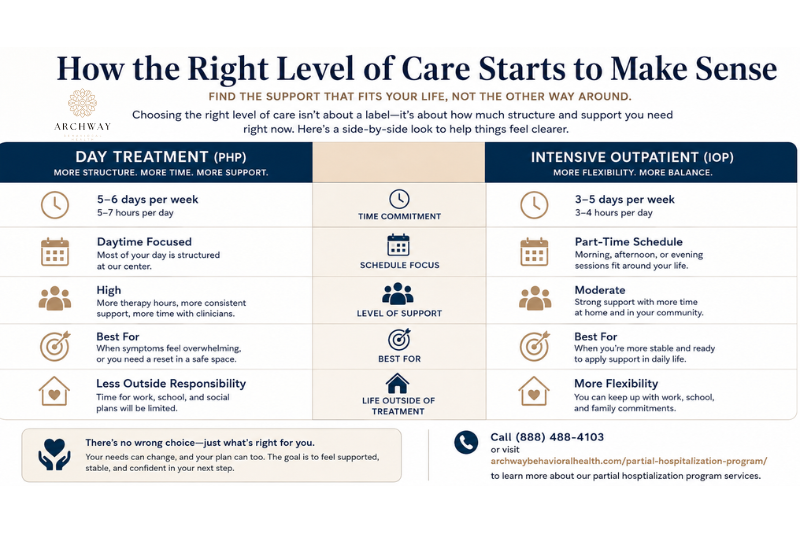
Step 2: Picture Your Week, Not the Program Name
Instead of thinking in clinical terms, imagine your weekly schedule.
One option feels like:
- A few days a week
- A few hours at a time
- Still balancing work, school, or home life
The other looks more like:
- Most of your day is structured
- Multiple therapy sessions
- Less room for outside responsibilities
That’s the real difference.
Not better. Not worse. Just more or less immersive support.
Step 3: Understand What “More Intense” Actually Means
Intensity doesn’t mean harsh or overwhelming.
It usually means:
- More time with clinicians
- More consistency in your routine
- Less space for avoidance
For some people, that feels like relief.
For others, it feels like too much—at least at first.
A simple way to think about it:
- If your current environment is helping you stay stable, a lighter structure might work
- If your environment is part of the struggle, more structured daytime care can be a turning point
Step 4: Pay Attention to Your Energy, Not Just Your Symptoms
This is where people often get stuck.
You might think:
- “I’m not that bad”
- “Other people probably need more help than I do”
But a better question is:
- How much energy does it take to hold everything together right now?
If you’re exhausted from managing it all alone, that matters.
If your days feel unpredictable or heavy, that matters too.
Sometimes the right level of care isn’t about severity—it’s about how supported you feel navigating it.
Step 5: Know That Mental Health and Substance Use Often Overlap
A lot of people searching for clarity are dealing with more than one thing at once.
Anxiety and drinking.
Depression and substance use.
Stress that turns into coping patterns you didn’t plan for.
That overlap can make decision-making harder—but it also means you may benefit from more integrated support, like help in dual diagnosis, where both sides are treated together instead of separately.
Step 6: Let the Right Level Meet You Where You Are
You don’t have to “earn” a certain level of care.
You don’t have to prove anything.
The goal is simple:
- Enough support to feel steady
- Enough flexibility to keep moving forward
And that can change over time.
Some people start with more structure and step down later.
Others begin with a lighter approach and adjust if needed.
There’s no wrong entry point—just the next right step.
A Simple Way to Ground Yourself
If everything still feels unclear, try this:
Ask yourself:
- Do I need more support than I currently have?
- Would structure help me feel safer or more stable?
If the answer is even maybe, it’s worth exploring.
Because clarity doesn’t usually come from overthinking—it comes from trying the right level of support and seeing how it feels.
Ready to Talk It Through?
You don’t have to figure this out alone.
Call (888) 488-4103 or explore our partial hospitalization program services to learn more about your options and what might actually fit your life right now.
And if you’re the one writing content like this—this matters more than you think. Someone out there is reading quietly, trying to make a decision that could change everything. You’re helping them take that step.
