
Clinically reviewed by Victoria Passarelli, LMHC, Clinical Director, Archway Behavioral Health
There’s a version of teen depression most parents expect: a teenager who cries often, says they feel hopeless, and can’t get out of bed. Some teens present exactly like that. Most don’t.
The warning signs of depression in teenagers are more likely to look like irritability than sadness. Like a teen who quits the team they loved for no clear reason, sleeps until noon and still seems exhausted, or starts arguments over nothing and can’t explain why afterward. The presentation that most parents are waiting for–the one that looks unmistakably like depression–often arrives late, if at all.
This matters because the earlier depression is identified, the better outcomes tend to be. Don’t overlook the signs. Here’s what tends to show up first.
The Signs Most Parents Notice Too Late
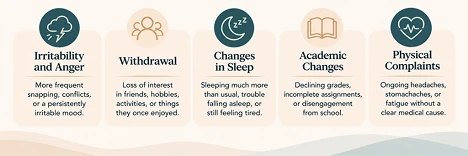
Persistent Irritability and Anger
The most underrecognized warning sign of teen depression isn’t sadness. It’s irritability. Teenagers who snap constantly, escalate arguments quickly, or seem angry at their family in ways that feel disproportionate and sustained are usually experiencing depression rather than “attitude problems.” The DSM-5 lists irritable mood as a core criterion for depression in children and adolescents specifically because it’s so common and so routinely missed.
Withdrawal From Things They Previously Valued
Dropping a sport they played for years. Leaving the friend group without explanation. Quitting clubs, hobbies, creative projects. When a teenager starts removing things from their life that used to matter–not gradually drifting to new interests, but actively disengaging–that pattern is worth paying attention to. It’s different from a teenager who was never particularly interested in extracurriculars. The key word is “previously.”
Changes in Sleep That Don’t Resolve
Teens with depression often start to sleep significantly more than usual, but they’re still exhausted. Or they lie awake until 3 AM despite being tired, then can’t function in the morning as a result. Both are common. The sleep disruption of depression doesn’t get better with weekends or school breaks the way a tired teenager’s sleep usually does.
Academic Changes That Look Specific
Depression doesn’t typically tank grades evenly. It tends to show up as incomplete assignments more than failed tests, as absence from classes a teenager used to attend reliably, or disengagement from teachers they previously had a relationship with. A teenager who was motivated and is now consistently not finishing work is a different picture than a teen who was always ambivalent about school.
Physical Complaints Without a Clear Medical Cause
Headaches and stomachaches that come and go, fatigue that doesn’t lift, and vague physical discomfort that pediatricians investigate without finding an explanation. These aren’t fabricated – they’re real somatic responses to the physiological state depression creates. They show up in adolescents particularly often, and they frequently delay recognition because the medical track absorbs attention.
Signs That Warrant Immediate Action
Some warning signs require a response now rather than a monitored “watch and wait” approach.
Statements about not wanting to exist – even indirect ones – warrant immediate attention. These often sound like “I wish I wasn’t here,” “everyone would be better off without me,” “what’s the point of anything?” These don’t always indicate a teenager is in crisis, but they do always indicate a conversation needs to happen with a clinician, not just a parent.
Evidence of self-harm: unexplained cuts or burns, wearing long sleeves in warm weather, or finding sharp objects in unusual places is another. Self-harm and depression frequently co-occur in adolescents. If you’re seeing both, the level of care needed likely involves more than weekly outpatient therapy.
If your teenager is in immediate danger, call or text 988 (Suicide & Crisis Lifeline) or go to the nearest emergency room.
The Difference Between Depression and Normal Adolescence
Two things distinguish depression from typical adolescent development: duration and functional impairment.
A rough week or two after a social conflict, a breakup, or a stressful exam period is normal. This is different from a sustained shift in baseline that persists for a month or more. A teen who’s less communicative at home but functioning at school, maintaining some friendships, and sleeping reasonably differs from one whose functioning across multiple domains (e.g., school, social activities) has deteriorated.
The clinical threshold for a depressive episode is two weeks – but parents don’t need to wait two weeks to start paying attention. If what you’re seeing has been present for more than 2-3 weeks across multiple areas of your teenager’s life, that’s enough to warrant a professional evaluation.
What to Do If You’re Concerned
What are the signs my teenager needs more than weekly therapy? Weekly outpatient therapy isn’t always sufficient for moderate-to-severe adolescent depression. If your teenager is already in therapy but symptoms are worsening or not improving, ask the therapist directly about a higher level of care. If your teen doesn’t have a therapist, start with the pediatrician. A medical evaluation rules out physical causes for some of the symptoms. Pediatricians can also conduct an initial mental health screening and refer to a behavioral health program.
Usually, a structured program that provides daily clinical support, such as a partial hospitalization program (PHP), is what’s needed. PHP involves about six hours of treatment per day, five days per week. An intensive outpatient program (IOP) is the next step down. IOP can act as a starting level of care for teens with more manageable symptoms, or it can be the next stage in treatment after PHP. IOP meets about three days per week for about three hours each day.
Have more questions? Contact us or start with a parent’s guide to helping a child in a mental health crisis.
Contact Archway Behavioral Health for Adolescent Mental Health Treatment in Florida
Archway Behavioral Health’s adolescent treatment program in Boca Raton offers PHP and IOP for teenagers ages 11-17 across Palm Beach and Broward counties. To speak with the admissions team, call (888) 488-4103, available 24/7. You can also verify your insurance coverage before your first call.
Frequently Asked Questions
How long do warning signs of depression last before it becomes clinical?
The clinical threshold is two weeks of persistent symptoms that interfere with daily functioning, but the duration alone isn’t the whole picture. A teenager whose functioning has deteriorated significantly in ten days warrants evaluation sooner than a teenager who’s had mild mood changes for three weeks. If you’re unsure, a pediatrician or behavioral health intake call is a low-commitment first step.
Can depression in teenagers look like anger instead of sadness?
Yes. This is one of the most important things parents need to know about teen depression. Irritability is a recognized criterion for depression in adolescents specifically. A teenager who seems persistently angry, who escalates conflicts quickly, and whose irritability is sustained rather than situational may be depressed.
What’s the first step if I think my teenager is depressed?
The pediatrician is usually the easiest entry point. They can rule out physical causes, do an initial screening, and make a referral. If symptoms are severe or escalating, calling a behavioral health program directly to discuss a clinical intake assessment skips a step.
Should I tell my teenager I think they’re depressed?
Yes, but carefully. Naming what you’ve specifically observed (“I’ve noticed you haven’t been sleeping well and you’ve seemed really down for the past few weeks”) tends to land better than a diagnosis (“I think you have depression”). The goal of the first conversation is to open dialogue, not to deliver a verdict.
