

I remember sitting in my car after an appointment, staring at the steering wheel, thinking, That’s it? That’s what everyone swears by?
I had finally reached out for help. I showed up. I talked. I did the worksheets. And somehow… I still felt anxious. So I quietly decided it “didn’t work.”
If that’s where you are, I want to say this first: you’re not broken. And you’re not the only one who’s walked away feeling underwhelmed.
If you’re considering trying again, or wondering whether something different might actually help, it’s worth understanding what real support for anxiety can look like—especially when it’s more structured and personalized, like the options outlined on this page about anxiety treatment in Boca Raton.
But before that, let’s talk about the part no one says out loud.
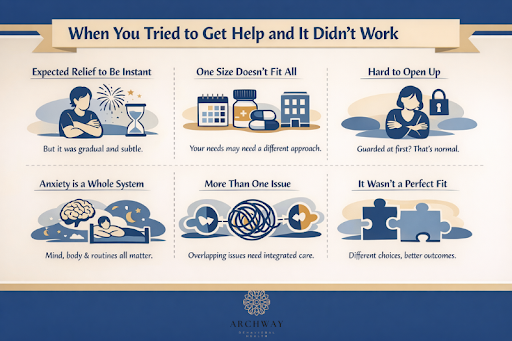
Sometimes We Expect Relief to Feel Dramatic
I thought progress would feel like a breakthrough. Like crying in an office and walking out lighter.
Instead, it felt subtle. Almost boring.
No one told me that reducing anxiety can feel less like fireworks and more like turning down background static. It’s gradual. It’s repetitive. It’s showing up on days when nothing feels urgent.
When I didn’t feel immediate relief, I assumed it meant failure.
It didn’t.
Not Every Approach Fits Every Person
Here’s something I wish I understood earlier: one format doesn’t work for everyone.
Maybe you tried weekly sessions and needed more consistent support. Maybe you needed multi-day weekly care to build momentum. Maybe medication was introduced too quickly or not explored thoughtfully enough.
Sometimes it’s not that you “failed” at anxiety treatment. It’s that the structure didn’t match the intensity of what you were carrying.
That mismatch can look like stagnation.
It’s not the same thing as hopelessness.
If You Were Guarded, That Makes Sense
I went in with walls up.
I didn’t trust the process. I didn’t trust that anyone could really understand what was happening in my head. I shared the safer parts of the story. The polished version.
Then I wondered why nothing shifted.
If you’ve been skeptical, flat, or emotionally checked out in sessions, that doesn’t make you resistant. It makes you human.
Trust builds slowly. And sometimes it builds better in environments that offer more continuity, not just one hour a week.
Anxiety Isn’t Just Thoughts, It’s a System
I thought my problem was “overthinking.”
But anxiety was also in my body. My sleep. My relationships. My constant scanning for what could go wrong.
Talking helped but it wasn’t enough on its own.
When care addresses routines, coping patterns, nervous system regulation, and the way stress spills into everyday life, things start to shift in a more grounded way.
It becomes less about “fixing” you and more about stabilizing the system you live in.
If You Have More Than One Thing Going On
This part matters.
If anxiety is tangled up with depression, trauma, or when mental health and substance use collide, a narrow approach can miss the full picture.
That’s where integrated support makes a difference. For some people, that might include specialized help in Dual Diagnosis—care that doesn’t treat one issue while ignoring the other.
When the layers are acknowledged together, progress often feels more real.
“It Didn’t Work” Might Mean “It Wasn’t the Right Fit”
I used to say, “I already tried that.”
What I meant was: I tried one version of it.
There’s a difference.
Different levels of care. Different clinicians. Different pacing. Different environments. Sometimes even just being in a place in your life where you’re actually ready to be honest changes everything.
You’re allowed to be disappointed by your first experience.
You’re also allowed to try again without feeling foolish for it.
You Deserve More Than White-Knuckling Through Life
Living with constant anxiety can start to feel normal. You function. You get things done. You smile when needed.
But inside, you’re bracing.
Real support doesn’t erase your personality or flatten you out. It helps you breathe without rehearsing worst-case scenarios all day. It gives you tools that actually stick.
If you’re in South Florida and wondering whether a different level of support might finally feel aligned, you can explore your options for care through this page on anxiety treatment in Boca Raton. No pressure. Just information.
Because sometimes the truth about getting help is this:
It’s not about trying harder.
It’s about finding the right fit.
If you’re ready to talk it through with someone who won’t minimize your past experience, call (888) 488-4103 or visit our page to learn more about our anxiety treatment services in Boca Raton. You don’t have to decide everything today. Just take the next honest step.
