

You didn’t disappear because you’re lazy or beyond help. You left because something didn’t click, didn’t feel safe, or didn’t fit your life the way you needed it to.
And that matters more than you think.
If you’re even considering going back—or trying again—you’re already doing something different.
You Didn’t “Drop Out”—You Hit a Wall
Most people don’t walk away from care because they don’t care.
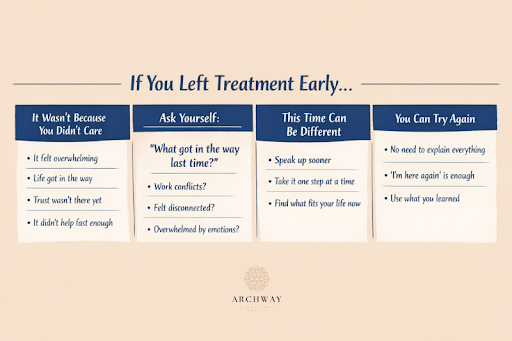
They leave because:
- It felt overwhelming
- Life didn’t slow down just because treatment started
- Emotions got louder instead of quieter
- Or honestly… it just didn’t feel like it was helping fast enough
That doesn’t mean the structure failed you. It means the way you were trying to use it didn’t match what you needed at the time.
There’s a difference.
Before You Go Back, Ask This One Honest Question
Not “What did I do wrong?”
Ask:
“What actually got in the way last time?”
Be specific. Not vague guilt—real friction.
Was it:
- Your work schedule clashing with sessions?
- Feeling disconnected from the group?
- Not trusting the process yet?
- Or comparing yourself to people who seemed “worse” or “better” than you?
This is where things shift. Because now you’re not just returning—you’re adjusting.
Use the Structure Differently This Time
Programs like this aren’t something you “complete.” They’re something you use.
Last time, maybe you:
- Sat quietly and waited to feel better
- Avoided sharing because it felt uncomfortable
- Treated it like something being done to you instead of with you
This time, try flipping that.
Speak earlier—even if it’s messy.
Say when something isn’t landing.
Let it be imperfect.
The people who get the most out of care aren’t the most “put together.” They’re the most honest.
If You Have a Job, This Might Have Felt Impossible
Let’s be real—this is where a lot of people check out.
Balancing treatment with work can feel like:
- You’re risking your job
- You’re falling behind
- You’re constantly choosing between survival and healing
That’s where understanding options matters.
Some people do better with flexible, multi-day weekly treatment that fits around work. Others need more structured daytime care for a while to stabilize.
This is where conversations around iop vs php actually become personal—not clinical.
It’s not about which is “better.”
It’s about which one you can realistically show up for right now.
If you’re unsure, start by exploring your options through this intensive outpatient program and see how it could fit into your actual life—not an ideal version of it.
You’re Allowed to Come Back Without Explaining Everything
A lot of people stay away because they think they owe someone a perfect explanation.
You don’t.
You don’t need a speech.
You don’t need a clean story.
You can come back and simply say:
“I’m here again.”
That’s enough to start.
If Mental Health Was Part of It, That Matters More Than You Think
Sometimes what gets labeled as “not trying hard enough” is actually something deeper.
If your anxiety spiked…
If your thoughts felt too loud…
If your mood dropped and you couldn’t push through it…
That’s not failure. That’s information.
For many people, treatment works differently when both sides are addressed—especially when mental health and substance use collide. If that was part of your experience, exploring more integrated support like treatment in dual diagnosis can change how this feels the second time around.
This Time Isn’t About Starting Over—It’s About Starting Smarter
You already know what it feels like to walk in.
You already know where you tend to pull back.
That’s not a disadvantage. That’s insight.
Think of this as a second draft—not a reset.
And second drafts are usually where things finally start to make sense.
You’re Not Too Late—and You’re Not “That Person”
There’s no invisible list of people who are “allowed back” and people who aren’t.
No one is sitting there thinking you failed.
If anything, the door is still open wider than you think.
Ready to Try Again—On Your Terms?
You don’t have to overthink this part.
Call 888-488-4103 or explore our intensive outpatient program services to learn more about your options.
If last time didn’t work, that doesn’t mean this won’t.
It just means this time, we do it differently.
