

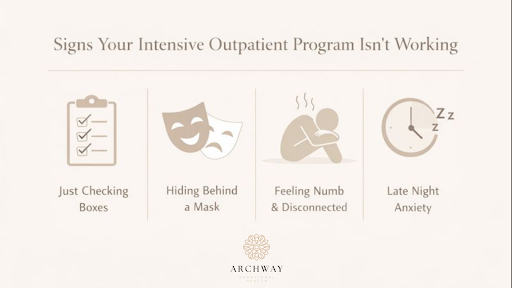
You’re getting the work done. You’re showing up to your intensive outpatient program (IOP) three times a week. You’re nodding at the right moments in group. You’re even managing not to cancel your therapist last minute. But underneath the checkbox routine… you still feel like hell.
This isn’t laziness. It’s strategy. It’s what high-functioning people do: survive, perform, move on. But when you treat your IOP like a task instead of a lifeline, it stops working fast.
Learn more about our intensive outpatient program here.
You’re “Doing the Work” But Nothing’s Changing
Let’s be real: You know how to succeed. You know how to get an A in any system you step into including recovery. But healing doesn’t play by those rules.
You can’t out-schedule, out-read, or out-perform your pain. If you’re showing up physically but still emotionally checked out, IOP will feel like a waste of time. Not because it is but because you’re blocking what it’s trying to give you.
The Hustle Mask Works Until It Doesn’t
There’s a unique kind of burnout that comes from looking “fine” while quietly unraveling. You might be leading meetings at work, running carpools, and hitting the gym while white-knuckling sobriety or emotionally numbing out in every session.
This is the paradox of the high-functioning client: everyone thinks you’re okay… including you, until suddenly you’re not. And IOP can’t break through the mask if you’re too busy holding it up.
Recovery Isn’t a Performance
Here’s the hard truth most high-achievers hate: recovery doesn’t reward effort the way school or work does. You don’t get extra credit for showing up tired or managing your schedule perfectly.
You get better when you stop performing.
When you bring your mess, not your bullet points. When you speak up even though your voice shakes. When you stop worrying about being “the good client” and start being the real one.
You Don’t Need to Fall Apart to Be Taken Seriously
You don’t have to hit a dramatic rock bottom for IOP to help you. But you do have to stop minimizing your own pain.
The very fact that you’ve been holding it all together while slowly dying inside is enough.
Your substance use, anxiety, or depression doesn’t have to “look bad enough” to matter. In fact, your ability to keep functioning might be the very thing keeping you stuck.
Explore real treatment options in Dual Diagnosis that don’t require you to crash and burn first.
The “I’m Fine” Strategy Will Cost You
High-functioning burnout is sneaky. It lets you think you’re okay because the house is clean and the emails are answered. But the cost shows up in private:
- Middle-of-the-night panic attacks
- Drinking more than you meant to again
- Disconnecting from people who love you
- Sitting in group, thinking, “This isn’t working for me,” while refusing to open up
It’s not weakness to let people see you. It’s the beginning of healing.
What IOP Is Actually For
IOP isn’t just a lighter version of inpatient care. It’s a container for grief, for trauma, for truth.
It’s the place where high-functioning people finally stop pretending.
Where showing up vulnerable counts more than showing up polished. Where you don’t need to impress anyone to be worth helping.
If you’re tired of trying to win at recovery, maybe it’s time to actually let it in.
📞 Ready to stop performing and start healing?
Call ((888) 488-4103 or visit us to learn more about our intensive outpatient program services.
