

You can feel it in your chest.
Something is wrong. Your child is isolating, panicking, spiraling—or barely functioning. And when you suggest help, they shut down. “I’m fine.” “I don’t need therapy.” “Stop overreacting.”
If you’re quietly searching for an anxiety treatment program at 2 a.m., you are not dramatic. You are scared. And you love them.
We see families in this exact moment every day at Archway Behavioral Health.
The Fear Parents Don’t Say Out Loud
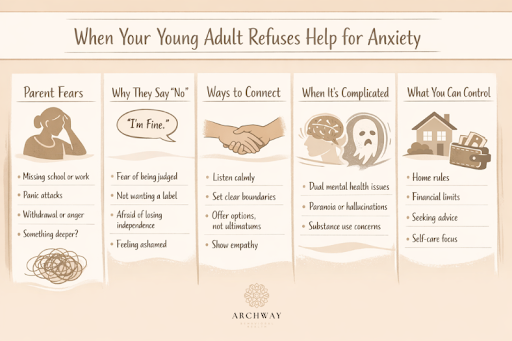
You’re not just worried about anxiety.
You’re worried about:
- The missed classes or work shifts
- The sudden rage or withdrawal
- The panic attacks that seem to come from nowhere
- The way their personality feels… dimmer
You might even be asking yourself if this is something more serious. If anxiety has tipped into depression. If trauma is surfacing. If you missed signs earlier.
That spiral of “what if” can feel endless.
But here’s what we want you to hear: panic in a parent is not weakness. It’s attachment. It’s love trying to problem-solve.
Why Young Adults Refuse Help (Even When They’re Struggling)
Refusal doesn’t always mean denial.
Sometimes it means:
- They’re ashamed.
- They don’t want a label.
- They’re afraid treatment means something is “seriously wrong.”
- They think accepting help equals losing independence.
Anxiety is tricky that way. It convinces people that avoiding discomfort is safer than facing it. So when you suggest support, it can feel to them like you’re pushing them toward the very thing they’re terrified of.
That doesn’t mean you stop offering help.
It means the approach matters.
What Actually Moves the Needle
Pressure rarely works. But clarity does.
Instead of:
“You need to go. This is out of control.”
Try:
“I can see how much you’re hurting. We don’t have to solve everything today—but we do need support.”
You are shifting from control to collaboration.
We often guide families toward structured daytime care or multi-day weekly treatment when anxiety has started interfering with daily life. Not because someone is “broken,” but because intensity sometimes requires consistency.
Think of it like physical therapy after an injury. The body needs repetition to relearn safety. The brain does too.
When Anxiety Isn’t the Only Thing Going On
Sometimes what looks like anxiety is layered with other mental health concerns.
You may notice:
- Paranoia or distorted thinking
- Severe mood swings
- Complete emotional shutdown
- Substance use as self-medication
If mental health and substance use collide, or symptoms feel more complex, families may need more comprehensive support like dual-focused care. For example, some families seek support in Dual Diagnosis when anxiety overlaps with other challenges.
And if symptoms include hallucinations or breaks from reality, exploring specialized care in Psychotic Disorder may be important.
These possibilities can sound overwhelming.
But clarity reduces chaos. Naming what’s happening creates options.
“But They’re 19… I Can’t Force Them.”
This is one of the hardest truths.
Once your child is legally an adult, your leverage changes.
What you can control:
- The boundaries in your home
- What you financially support
- The conversations you’re willing to have
- Whether you consult professionals for guidance
You are not powerless. You are just operating differently now.
Sometimes the first step isn’t convincing your young adult to attend an anxiety treatment program. Sometimes it’s the parent getting consultation, education, and a plan.
That shift alone can change the dynamic.
A Different Way to Think About This
Right now, it may feel like you’re standing outside a locked door.
You’re knocking. They’re inside. And neither of you knows how to open it.
Treatment isn’t about breaking the door down.
It’s about helping them feel safe enough to unlock it themselves.
That safety often comes from:
- Non-blaming language
- Consistent boundaries
- Clear options
- A steady tone instead of a frantic one
And yes, professional support that understands young adult anxiety specifically.
You are not overreacting. You are responding to something real.
If you want to understand what supportive, structured care could look like for your family, we’re here to talk it through without pressure, without judgment.
Call (888) 488-4103 or visit our anxiety treatment program services to learn more about our anxiety treatment program services in Boca Raton.