

You’ve tried everything you know how to do therapy, medication, late-night talks, watching closely, praying harder. But your child is still slipping. When home stops being enough, it’s not a failure, it’s a signal. A depression treatment program might be the step that finally gives your loved one the environment and expertise they need to stabilize and heal. Archway’s depression treatment program was built for exactly these moments.
What a Depression Treatment Program Can Offer That Home Can’t
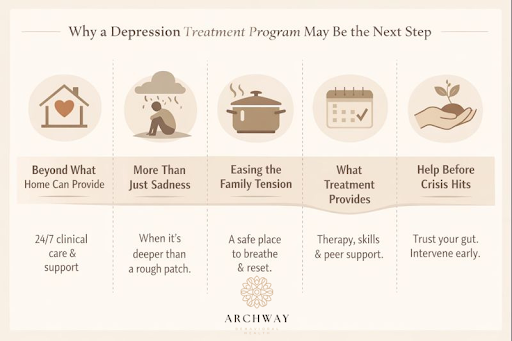
Home is love. But home isn’t a clinical environment.
Depression can warp a young person’s sense of reality. They may not be able to recognize their own symptoms, much less talk about them. A structured treatment program provides something no parent can replicate on their own: a team of licensed clinicians monitoring mood changes, medication response, and behavioral patterns in real-time.
More than just support, it’s supervision with skill.
The Line Between “Just Sad” and Something Deeper
It’s hard to know when sadness becomes something more.
If your child is isolating, sleeping excessively, skipping responsibilities, or expressing hopelessness, you’re right to be concerned. These aren’t just mood swings. These are warning signs that professional care is warranted. And while outpatient therapy can help, it’s not always enough when symptoms become unmanageable at home.
Sometimes the environment has to change for the healing to begin.
When Home Feels Like a Pressure Cooker, Not a Safe Place
You’re not doing anything wrong. But crisis makes a house feel like it’s always on the edge.
Every missed class or slammed door starts to feel like a lit fuse. Siblings walk on eggshells. Parents stay up all night in fear. This isn’t sustainable for anyone. A depression treatment program creates breathing room. It provides safety, structure, and time for everyone involved to reset and regroup.
The goal isn’t to take them away, it’s to give them a place to come back from.
What Happens Inside a Depression Treatment Program?
A strong program focuses on stabilization first, then growth.
That often includes:
- Psychiatric evaluations and medication support
- Daily therapy sessions (individual, group, family)
- Life skills building and emotional regulation tools
- Peer support in a safe, monitored environment
At Archway, we tailor our programs to meet the unique needs of each client because no two young adults experience depression the same way.
For those with co-occurring conditions, we also offer specialized support in Dual Diagnosis.
You Don’t Have to Wait for Rock Bottom
One of the hardest truths about depression is that it doesn’t always look like a crisis.
Sometimes it looks like your child saying they’re fine when they’re not. Sometimes it looks like subtle changes that only a parent would notice. You don’t need a suicide attempt or emergency hospitalization to justify seeking help. Trust your instincts. If it feels like something’s wrong, that’s reason enough.
Early intervention isn’t overreacting, it’s protecting their future.
There’s Still a Way Through This
You may feel powerless. But you’re not alone. And this moment, scary as it is, is not the end of the road. There are real, evidence-based ways to help your child come back to themselves.
Explore treatment options that offer structure, care, and relief—not just for your child, but for your entire family. You deserve support, too. And if your child’s symptoms include signs of detachment from reality, treatment options in Psychotic Disorder may also be worth exploring with a clinical team.
📞 Ready to take the next step?
Call (888) 488-4103 or to learn more about our depression treatment program services in Boca Raton.
