

It’s one of the hardest things to admit out loud:
“My child is depressed, anxious, and using again. And I don’t know how to help anymore.”
When depression is tangled up with anxiety and substance use, even the idea of a depression treatment program can feel miles out of reach. Not because the help isn’t out there but because everything in your child’s world (and yours) feels too fragile, too overwhelming, too uncertain.
This blog isn’t about clinical definitions. It’s about the very real heartbreak of watching someone you love collapse under the weight of it all and what might help when everything feels stuck.
It’s Not Just Depression, It’s Everything All at Once
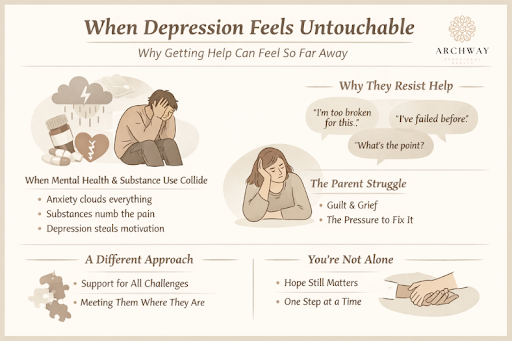
When your child is struggling with depression, it rarely shows up alone. Anxiety clouds every decision. Substances blur or bury the pain. And depression? It steals the will to even try.
This is where parents start to feel like they’re losing the thread. You may be wondering:
- “Do they need help for the anxiety first?”
- “Should we wait until they stop using?”
- “What if they refuse everything?”
These are normal questions. But they can trap you in wait-and-see mode while things get worse. The truth is: when depression, anxiety, and substance use collide, they tend to reinforce each other. Ignoring one doesn’t make the others disappear.
Why Your Child Might Resist the Very Thing They Need
You might think: “They’ve been to treatment before. They know what to do.”
But depression changes how a person sees themselves and the world. Layer on anxiety, and every option feels dangerous. Add substances, and even reality starts to bend.
Here’s what might be running through their mind:
- “I’m too broken for help.”
- “If I go back to treatment, it means I failed again.”
- “What’s the point? Nothing ever changes.”
This isn’t laziness or manipulation. It’s a pain speaking in its most defensive voice. A good structured treatment plan can interrupt this cycle but first, the fear has to be named.
The Parent Spiral: Guilt, Grief, and the Pressure to Fix It
You’ve probably asked yourself some version of this:
“Did I miss something? Did I do something wrong?”
The answer? No. You’re here. You’re trying. That matters.
But depression and substance use don’t follow rules. They don’t care how much you love your child or how many therapy appointments you schedule. They isolate and distort. And when your adult child pulls away or lashes out, it can feel like love isn’t enough.
That doesn’t make you a bad parent. It makes you a heartbroken one.
You Don’t Need a Perfect Plan, Just the Next Right Step
One of the most powerful shifts a parent can make is this:
Stop waiting for your child to be “ready.” Start looking for programs that meet them where they are.
At Archway, we understand that healing rarely happens in a straight line. That’s why our services are built to support people navigating more than one challenge at once because rarely is it just depression. Sometimes it’s depression and anxiety. Or depression and substance use. Or all three.
If your child needs support that understands the overlap, consider our support in Dual Diagnosis—a compassionate, evidence-based approach that holds space for everything they’re carrying.
When It Feels Like Nothing Will Work
Let’s name the fear that lives in your chest:
“What if we try again, and it still doesn’t help?”
You’re not alone in that thought. Many parents have watched their children cycle through treatment with what feels like no real change. But what if the problem isn’t them or you? What if the program they tried didn’t match what they actually needed?
The right treatment doesn’t just target symptoms. It builds trust. It accounts for anxiety. It works with (not against) the realities of substance use. And above all, it offers hope even when the person walking through the door doesn’t feel any.
You’re Allowed to Hope (Even If They Don’t Yet)
Hope isn’t naive. It’s not pretending everything’s fine. It’s deciding not to give up, even when you’re scared. Even when your child is angry, resistant, or numb.
The right kind of care in Psychotic Disorder or co-occurring condition support won’t shame you for hoping. It will meet your loved one with skill, steadiness, and respect whether they walk in ready or not.
And that includes programs that understand how hard it is to untangle the mix of mental health and substance use.
You’re Not the Only One Carrying This
If you’re here, reading this, it means you’re still trying and that matters.
📞 Call 888-488-4103 or visit our depression treatment program services to learn more about how we support people in . You’re not alone in this. And your next step doesn’t have to be perfect. Just real. Just yours.
