

Even when you’re proud of your choice to stay sober, it can still sting to watch your friends out living the “fun” life. Maybe you’re scrolling through beach day selfies, bar crawl videos, or neon-lit concerts—and instead of feeling strong, you feel… excluded. That’s not weakness. It’s something your brain is trying to process.
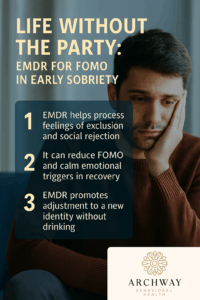
EMDR therapy (Eye Movement Desensitization and Reprocessing) was originally developed for trauma, but today, it’s also being used to support people in early recovery—especially young people navigating FOMO, social anxiety, and the emotional growing pains of sobriety.
This isn’t about pretending you don’t care about parties or friendships. It’s about giving your nervous system the tools to stop panicking when life shifts, people move on, and your identity starts to evolve. If you’re feeling like the “weird one” right now—EMDR might be exactly what helps you stay grounded.
1. EMDR Helps You Process the Emotional “Aftershock” of Sobriety
Sobriety isn’t just about not using. It’s about changing the context of your entire social life. For a lot of young adults, that means distancing from friend groups, skipping events you used to love, or facing the awkward silence when someone asks why you’re not drinking.
That emotional friction doesn’t just go away because you know you made a healthy choice. Your body might still interpret those moments as unsafe or shaming. EMDR helps your brain reprocess the moments that feel like social rejection or identity loss, so they don’t keep firing in the background.
It’s not about “forgetting”—it’s about letting your body stop reacting as if you’re still in danger of being left out, judged, or alone.
2. FOMO Is Real—and EMDR Can Help You Feel Less Hijacked by It
Fear of missing out isn’t just a joke or a meme. It’s a very real physiological response, especially if your old coping mechanisms revolved around being in the center of the action.
You might notice your chest tightening when you scroll past a party you weren’t invited to. Or your thoughts spiraling after a group text dies out. Or a rush of shame when someone says, “Wait, you don’t drink anymore?”
EMDR helps by calming the brain’s reactivity to those situations. Through a structured process, your therapist helps you target the core memory or belief system behind your reaction—like “I’m boring now” or “I don’t belong”—and process it in a way that doesn’t feel like reliving it.
One outpatient client put it like this:
“I used to freeze when I got texts from my old group chat. Like I was bracing for bad news. After a few EMDR sessions, I could actually read them without flinching.”
3. You Don’t Need to Have “Big T” Trauma to Benefit from EMDR
Let’s clear something up: EMDR isn’t only for war vets or people with a single defining trauma. Your emotional reality matters—even if you can’t point to one dramatic event.
In early sobriety, many of the triggers are small, repetitive moments that chip away at your confidence:
- Being the only one not drinking at a birthday dinner
- Realizing a friend only texts you to party
- Seeing someone post about “the best night ever” and knowing you weren’t invited
Each of these moments can quietly reinforce the belief that you’re no longer enough—or that sobriety means social death. EMDR helps identify those underlying beliefs and move them from the front row of your mental theater to the archives.
4. EMDR Makes Room for a New Social Identity (Without Erasing the Old One)
Many young people worry that sobriety will flatten their personality. That without a drink in hand, they won’t be funny. Or cool. Or worth inviting.
That fear isn’t just insecurity—it’s part of a real identity shift. And it’s hard.
EMDR allows you to examine the stories you’ve told yourself (or been told) about who you are in social spaces. Maybe it’s the belief that “I need alcohol to connect” or “People only like me when I’m loose.” By bringing these to the surface, EMDR helps you loosen their hold and write new narratives that actually reflect who you’re becoming.
You don’t need to become someone else. You just need space to reconnect with the parts of you that don’t depend on being buzzed to belong.
5. In Places Like Boca Raton, the Pressure to Be “Chill” Is Real
Let’s not pretend Boca is neutral ground. Between the social beach scenes, wellness influencers, and the ever-present brunch crowd, the cultural message is clear: be fun, be easygoing, be Instagrammable.
In that context, early sobriety can feel like swimming upstream. You’re not just saying no to substances—you’re saying no to a whole unspoken social script.
But you’re not the only one rewriting the rules. Looking for EMDR in Boca Raton, Florida? You’ll find people here who get it. Therapists who won’t shame your grief over leaving the party scene. Providers who know sobriety doesn’t mean disappearing—it means reshaping.
6. Early Sobriety Is a Weird, Wobbly Phase—EMDR Can Steady the Ground
Here’s the honest truth: Early sobriety is a socially weird phase. You’re not who you were. You’re not yet who you’re becoming. And in the meantime, you might feel like a ghost at your own life.
You’re not imagining it. This is the emotional in-between.
EMDR doesn’t fast-forward you out of this phase. But it can help you stop spinning. It can help you reprocess the little betrayals and hurts—so you can walk into new spaces with less fear. So you can tolerate awkwardness without shrinking. So you can stay present long enough to feel your new identity take root.
If you’re looking for EMDR in Boca Raton or surrounding areas like Coral Springs or Deerfield Beach, make sure the center you choose offers more than a buzzword. Look for real clinical integration.
FAQ: EMDR and FOMO in Early Sobriety
What exactly is EMDR?
EMDR (Eye Movement Desensitization and Reprocessing) is a therapy that helps people process difficult memories or emotional triggers. It uses bilateral stimulation (like guided eye movements) to help the brain “digest” stuck material and reduce distress.
Is EMDR just for trauma?
Nope. While it was developed for PTSD, EMDR is now widely used for anxiety, grief, addiction recovery, and even social confidence. If you’ve got emotional baggage from your past party life, it can absolutely help.
Will EMDR make me re-live painful memories?
It’s not like watching a horror movie of your worst moments. EMDR is designed to keep you grounded while gently visiting past experiences. You stay in control. Your therapist is there to help guide—not push.
How do I know if EMDR is right for me?
If you’re dealing with emotional reactivity, social anxiety, or recurring feelings of exclusion in sobriety, it’s worth a try. Learn more about EMDR therapy and talk to a provider about your goals.
Can I do EMDR if I’m still early in recovery?
Yes. Many people use EMDR alongside outpatient or aftercare programs. It can actually support relapse prevention by helping reduce the emotional pain points that often lead people to use again.
Feel like you’re the only sober person in the world? You’re not.
Call (888) 530-0227 or visit to learn more about our EMDR services in Boca Raton, Florida.
