

You don’t usually type something like “day program for depression near me” into Google on a good day.
You type it at 1:14am after another hard conversation. After your son says he’s “fine” but barely leaves his room. After your daughter stops answering texts. After weeks of wondering if this is burnout, depression, isolation, substances, or all of it tangled together.
Sometimes parents aren’t even searching for a program. They’re searching for proof that their child can still come back to themselves.
And that’s exactly why so many families eventually find themselves exploring structured daytime care that offers more support than weekly therapy alone.
Most Parents Aren’t Looking for “Treatment” at First
They’re looking for relief.
Relief from the constant scanning. The pit in the stomach every time the phone rings. The exhaustion of trying to say the right thing without pushing too hard.
A lot of young adults struggling with depression don’t look visibly “unwell” all the time. They might still joke at dinner. Go to work occasionally. Scroll TikTok for hours. Sleep all day and then suddenly seem okay for two days straight.
That inconsistency can make parents question themselves.
“Am I overreacting?”
“Did I miss something?”
“Why does it feel like I’m losing my child in slow motion?”
Depression at this age often hides behind irritability, withdrawal, substance use, numbness, or complete emotional shutdown. And sometimes what families need is more consistent support than one therapy appointment a week can realistically provide.
That’s where a day program mental health approach can become part of the conversation — not as punishment, but as stabilization.
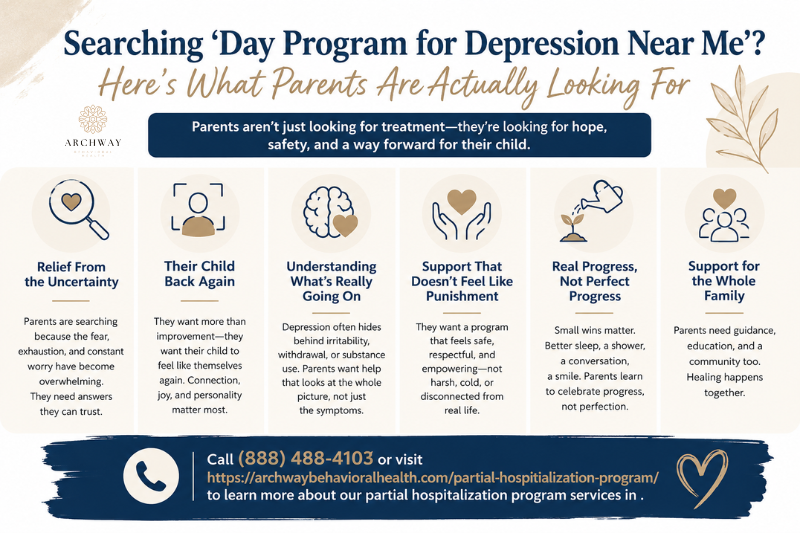
They Want Their Child to Feel Like Themselves Again
This is the part parents say quietly.
Not “I want them to succeed.”
Not “I want them to stop making bad choices.”
They say:
“I just want my kid back.”
That sentence carries so much grief inside it.
Depression can flatten someone’s personality in ways that are hard to explain. A once funny, engaged, emotionally expressive young adult can start to feel distant — like they’re watching life through fogged glass.
One parent described it like this:
“It felt like my son was still physically in the house, but emotionally somewhere I couldn’t reach.”
That’s why families often begin searching for more immersive support. Not because they’ve given up, but because love sometimes reaches a point where it needs backup.
The Fear Gets Bigger If Substance Use Is Involved
A lot of parents don’t know how to separate depression from substance use anymore because the two often start feeding each other.
Maybe your child drinks to numb anxiety. Maybe marijuana became an all-day escape. Maybe pills entered the picture quietly. Maybe you aren’t even sure what’s happening anymore — just that something feels off.
That confusion is incredibly common.
And honestly, many families searching for depression support are also quietly trying to understand what happens when mental health and substance use collide. In situations like these, finding compassionate support in Dual Diagnosis can help families make sense of behaviors that feel chaotic or frightening.
Not every young adult needs live-in treatment. But many need more structure, accountability, and emotional support than they’re currently getting.
A Good Program Shouldn’t Feel Like Punishment
Parents worry about this constantly.
They picture cold hallways. Shame. Labels. Their child feeling trapped or “sent away.”
But effective care for depression usually looks much more human than people expect.
It can look like:
- Group therapy that helps someone feel less alone
- Psychiatric support that actually listens
- Routine returning slowly
- Meals eaten consistently again
- Sleep stabilizing
- Someone finally saying, “I don’t think I can do this alone anymore”
There’s something powerful about being around other people who understand emotional exhaustion firsthand. Isolation tells people they’re broken. Connection interrupts that story.
A strong day program mental health environment doesn’t try to erase someone’s identity. It helps them reconnect with it.
Progress Usually Looks Smaller Than Parents Expect
This part matters.
Sometimes parents hope for a dramatic breakthrough moment. A giant emotional speech. Immediate motivation. Gratitude.
But healing from depression often happens quietly.
Your child gets out of bed before noon.
They answer a text.
They shower without being reminded.
They make eye contact again.
They laugh once — unexpectedly — and for a second you hear them in it.
Recovery can feel less like fireworks and more like watching someone slowly come back into focus.
And yes, there are setbacks sometimes. Hard days. Resistance. Emotional whiplash. Especially with young adults.
But families often discover something important during this process:
You do not have to carry the entire weight of saving your child by yourself.
Some Parents Need Support Too
This is the part almost nobody says out loud.
You’re tired too.
You’ve probably spent months — maybe years — monitoring moods, researching symptoms, replaying conversations, trying not to panic in front of everyone else.
Parents living through this kind of uncertainty often become emotionally hypervigilant. Your nervous system never fully relaxes.
That’s why good treatment doesn’t just focus on the person struggling. It helps families breathe again too.
And if your child’s depression has included paranoia, emotional disconnection, or severe behavioral changes, exploring compassionate treatment options in Psychotic Disorder may help clarify what kind of support fits best.
Because sometimes the scariest part isn’t knowing what’s wrong. It’s feeling alone while trying to figure it out.
There’s No Perfect Time to Reach Out
A lot of families wait for absolute certainty before asking for help.
But depression rarely announces itself cleanly. It blurs lines. It makes people withdraw. It convinces families to minimize things until they’re overwhelmed.
You don’t have to wait for things to completely fall apart before exploring options.
Sometimes the bravest thing a parent does is simply admit:
“This has gotten too heavy for us to manage alone.”
Call (888) 488-4103 or explore Archway Behavioral Health’s partial hospitalization program services to learn more about supportive daytime treatment options for depression and co-occurring mental health challenges.
