

If you’re a parent watching your child struggle with frightening thoughts, it can feel like the ground has shifted beneath you. Maybe they’ve admitted to thinking about hurting someone, a loved one, or even a child. Maybe they’re terrified by the thoughts themselves.
One of the most important things to know is this: disturbing thoughts do not automatically reflect someone’s character, intentions, or desires.
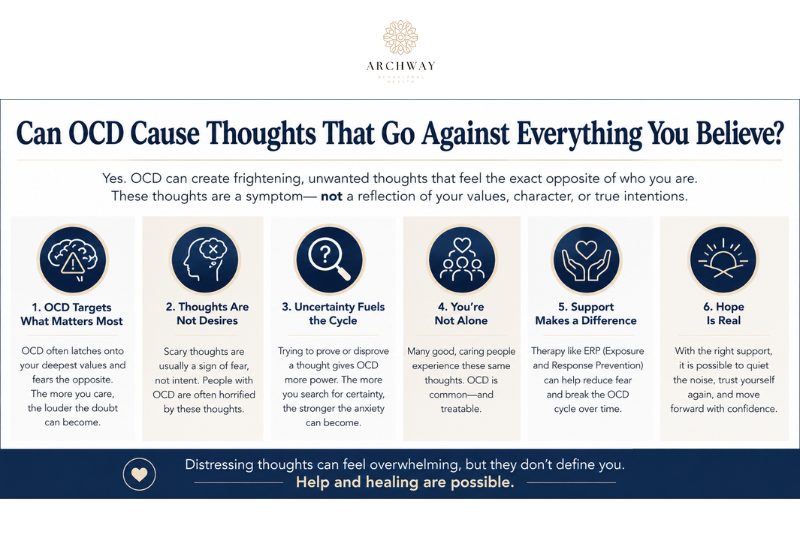
For many people with OCD, these thoughts are the exact opposite of what they want, believe, and value. Understanding that distinction can bring a tremendous amount of relief.
If you’re trying to make sense of what your family is experiencing, learning more about OCD treatment and support can be an important first step.
Why OCD Often Targets What Matters Most
OCD doesn’t usually attack random subjects.
Instead, it tends to latch onto the things a person cares about most. Someone who deeply values kindness may become obsessed with fears of being cruel. A devoted parent may become consumed by fears of harming their child. A person with strong moral beliefs may worry they’ve done something terrible.
It’s as if OCD finds a person’s deepest values and then asks, “What if the opposite were true?”
That question can become so loud and repetitive that it feels impossible to ignore.
Scary Thoughts Are Often a Sign of Fear, Not Desire
One of the biggest misconceptions about OCD is that unwanted thoughts reveal hidden wishes.
In reality, the opposite is often true.
People with OCD are usually horrified by these thoughts. They may spend hours analyzing them, seeking reassurance, avoiding situations, or trying to prove to themselves that they would never act on them.
Imagine a smoke alarm that goes off every time someone makes toast. The alarm is real, but the fire isn’t.
OCD can work in a similar way. The brain sends a false danger signal, creating intense fear around something that isn’t actually a threat.
Why These Thoughts Feel So Convincing
Many parents ask, “If my child doesn’t want these thoughts, why do they seem so upset by them?”
The answer lies in how OCD interacts with uncertainty.
Most people can dismiss a strange thought and move on. Someone with OCD may feel compelled to investigate it.
Questions start multiplying:
- What if this thought means something?
- What if I’m dangerous?
- What if I lose control?
- What if everyone else knows something I don’t?
The more they search for certainty, the stronger the obsession often becomes.
This cycle can make intrusive thoughts about harm feel frighteningly real, even when there is no desire or intention behind them.
What Parents Often Notice First
Many young adults struggling with OCD don’t immediately say, “I think I have OCD.”
Instead, parents may notice changes such as:
- Repeated requests for reassurance
- Confessing thoughts over and over
- Avoiding children, family members, or certain situations
- Excessive guilt about unlikely scenarios
- Constant checking of memories or actions
- Intense anxiety that seems disconnected from reality
These behaviors can be confusing because they often look very different from the stereotypical image of OCD that focuses only on cleanliness or organization.
Responding Without Panic
Hearing your child describe disturbing thoughts can be alarming.
Your instinct may be to immediately reassure them, analyze the thoughts, or search for a reason they are happening.
While those reactions come from love, it’s often more helpful to stay calm and recognize that the distress itself may be part of the condition.
A simple response such as, “I can see how upsetting this is for you,” can be more helpful than trying to prove the thought isn’t true.
Families often benefit from professional guidance that helps them understand the difference between supporting a loved one and accidentally feeding the OCD cycle.
For individuals who are facing multiple mental health challenges at once, specialized help in Dual Diagnosis may also provide additional support.
Hope Is Possible
Many families spend months or years fearing that these thoughts reveal something dangerous about their loved one.
In many cases, they don’t.
OCD can create mental false alarms that feel incredibly convincing. The fear is real. The distress is real. But the presence of a thought does not make it a wish, intention, or prediction.
With proper treatment and support, people can learn to respond differently to these fears and regain confidence in themselves.
If symptoms become severe or begin overlapping with other complex mental health concerns, exploring specialized care, including help in Psychotic Disorder, may help clarify what is happening and what kind of support is needed.
Call (888) 488-4103 or visit our OCD services to learn more about our mental health, OCD services.
