

I remember sitting in my car after work, staring at the steering wheel, trying to convince myself I was fine.
I had a job. I paid my bills. Nobody was calling me from jail. My family didn’t know how much I drank, and honestly, I planned to keep it that way.
From the outside, my life looked stable.
Inside, I was exhausted.
When I finally started looking at treatment options, I assumed it was all or nothing. Either I kept pretending everything was under control, or I disappeared into live-in treatment for weeks.
I wasn’t ready for that. More importantly, I didn’t think I needed it.
What I needed was structure, accountability, and a way to get help without completely stepping away from my responsibilities. That’s what I found through an intensive outpatient program.
I Was Functioning, But I Wasn’t Living
For years, I used my responsibilities as proof that I didn’t have a problem.
I showed up to work.
I paid my mortgage.
I answered emails.
I made dinner.
What I didn’t talk about was how much energy it took to keep everything from falling apart.
Every day felt like carrying a backpack full of bricks that nobody else could see.
I wasn’t thriving. I was surviving.
That’s a distinction a lot of high-functioning people miss.
Just because you’re still performing doesn’t mean you’re okay.
The Idea of Residential Treatment Felt Too Big
I want to be clear about something.
Residential treatment saves lives. Some people absolutely need round-the-clock support, and there’s no shame in that.
But I kept using residential treatment as an excuse not to get help at all.
I’d tell myself:
“If I can’t leave work, then treatment isn’t possible.”
“If I can’t disappear for a month, then I just have to figure this out myself.”
That thinking kept me stuck far longer than I needed to be.
Once I learned there were options between doing nothing and entering live-in treatment, everything changed.
I Needed Accountability More Than Isolation
One thing nobody told me was that I didn’t need to be removed from my life.
I needed support while living my life.
That’s a huge difference.
The real challenge wasn’t staying sober inside a treatment facility. The real challenge was learning how to handle Tuesday afternoons, stressful meetings, family conflict, and boredom without reaching for a drink.
Structured treatment gave me a place to practice those skills in real time.
I could attend therapy, connect with peers, and then go home and apply what I was learning immediately.
That mattered more than I realized.
Seeing the Schedule Actually Reduced My Anxiety
Before I started treatment, I was convinced it would consume my entire life.
I pictured endless appointments and no flexibility.
The reality was different.
Learning about the IOP schedule and hours helped me understand what treatment would actually look like.
Instead of imagining worst-case scenarios, I could see a realistic commitment that fit around work and family obligations.
Ironically, having a schedule made me feel less trapped, not more.
I stopped spending every day negotiating with myself about whether I needed help.
The decision was already made.
All I had to do was show up.
Recovery Started Looking Practical Instead of Impossible
The biggest shift wasn’t physical.
It was mental.
Treatment stopped feeling like some dramatic life event and started feeling like a practical solution to a problem that had been draining me for years.
I met people who looked a lot like me.
Professionals.
Parents.
Business owners.
People who had spent years convincing themselves they weren’t struggling enough to deserve help.
Many were also dealing with deeper issues underneath the substance use. For some, it was anxiety, depression, or trauma. For others, it was a situation where mental health and substance use collided, requiring specialized support in Dual Diagnosis.
That was eye-opening.
I wasn’t uniquely broken.
I was carrying something I could no longer manage alone.
The Goal Was Never to Escape My Life
This might be the most important thing I learned.
Treatment wasn’t about escaping my life.
It was about getting my life back.
The version of me that walked into treatment was constantly managing secrets, stress, and fear.
The version that came out wasn’t magically fixed.
But I was honest.
I was present.
I slept better.
I laughed more.
I wasn’t spending every waking hour trying to keep a fragile system from collapsing.
That’s what recovery gave me.
Not perfection.
Relief.
And if you’re reading this while quietly wondering whether you need help, maybe the question isn’t whether your life looks bad enough.
Maybe the question is whether you’re tired of carrying it alone.
If mental health symptoms are also part of the picture, exploring additional care in Psychotic Disorder or other specialized services may be an important part of recovery.
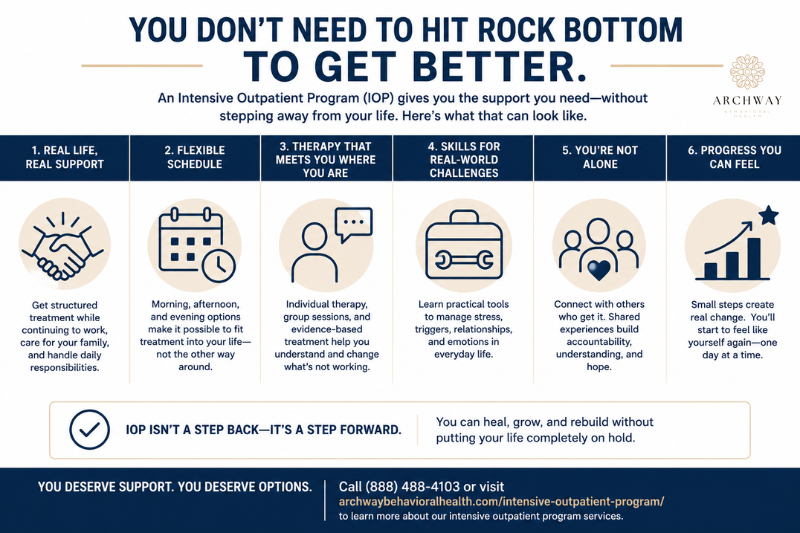
You Don’t Have to Wait for Everything to Fall Apart
I spent years believing treatment was reserved for people whose lives looked worse than mine.
That belief cost me time.
You don’t have to lose everything before you ask for help.
You don’t have to hit some dramatic rock bottom.
You don’t have to prove you’re struggling enough.
Sometimes the strongest decision is admitting that what you’re doing isn’t working anymore.
Call (888) 488-4103 or visit our intensive outpatient program services to learn more about our intensive outpatient program services.
