

I remember sitting in my car outside work thinking, “I can keep doing this for maybe six more months.” Not because I was falling apart publicly. Nobody at work knew. My calendar was full. Bills were paid. I still answered texts with “all good.”
But every day felt like dragging a soaked mattress uphill.
That’s the weird thing about high-functioning addiction or burnout. You don’t collapse dramatically. You slowly disappear inside your own routine.
If you’re comparing treatment options because you’re terrified of losing your job, your identity, or the version of you everyone depends on, you’re not alone. A lot of people searching for answers about structured outpatient support aren’t asking, “Do I need help?” They’re asking, “Can I get help without detonating my entire life?”
And honestly? That’s a fair question.
The Real Question Usually Isn’t About Treatment
People say they’re comparing schedules or program intensity.
What they’re really asking is:
“How much can I admit is wrong before everything changes?”
Because if you’ve been holding it together for a long time, even looking into treatment can feel dangerous. You worry that once you say it out loud, you’ll suddenly become “someone with a problem.”
Meanwhile, your actual life is getting smaller.
You stop sleeping well. You start managing your emotions like a hostage negotiator. You build your week around recovery from the weekend. Or drinking through the workweek. Or hiding panic attacks between meetings.
From the outside, you still look functional.
Inside, you feel like a phone permanently stuck on 4% battery.
Some People Need More Space Than They Want to Admit
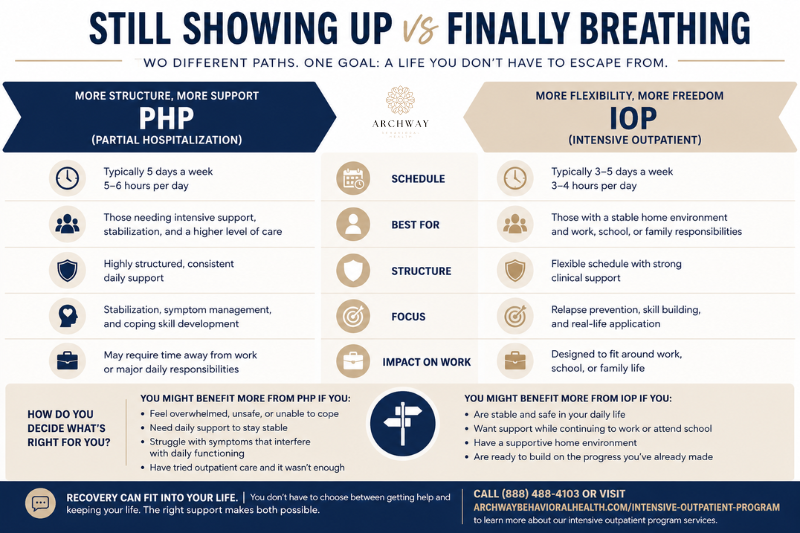
This is where the conversation around PHP vs IOP gets emotionally messy.
A lot of high-functioning people automatically choose the lighter option because they want proof they’re “not that bad.” They pick the schedule that disrupts life the least — even if it’s not enough support.
That’s not weakness. That’s fear.
But there’s also another truth nobody talks about enough: some people genuinely can keep working while getting help. The key is being honest about what kind of support actually matches your reality.
Here’s the simplest way to think about it:
More instability or risk⇒More structure needed\text{More instability or risk} \Rightarrow \text{More structure needed}More instability or risk⇒More structure needed
If your mental health, drinking, substance use, or emotional state is actively unraveling your ability to function safely, a more structured daytime schedule may protect your life more than your current “productivity” ever could.
If you still have stable footing and need intensive support without fully stepping away from responsibilities, multi-day weekly treatment may fit better.
But the answer isn’t about pride. It’s about honesty.
Keeping Your Job Doesn’t Mean Keeping Your Sanity
There’s this fantasy high-functioning people carry:
“If I can just maintain performance, I’m okay.”
But performance is not the same thing as wellness.
Some people keep working all the way into severe depression. Some keep closing deals while drinking every night. Some parents still make lunches every morning while secretly wondering how much longer they can live like this.
You can be reliable and deeply unwell at the same time.
That’s why this decision matters.
Not because treatment means failure. Because exhaustion eventually collects its debt.
The Best Program Is the One You’ll Actually Let Work
I’ve seen people force themselves into lower-support care because they were scared of stepping away from work.
I’ve also seen people enter more structured care for a few weeks and realize:
“Oh. This is the first time my nervous system has relaxed in years.”
That realization can hit hard.
Especially for people who built their identity around being dependable.
A lot of high-functioning adults don’t need someone to shame them into treatment. They need permission to stop white-knuckling their life.
And if mental health and substance use have started feeding each other, getting the right level of care matters even more. Sometimes what looks like “stress” is actually something deeper that needs integrated treatment options in Dual Diagnosis.
You Don’t Have to Earn Help by Falling Apart First
This might be the most important thing in this entire conversation.
You do not need a public collapse to deserve support.
You do not need a DUI, job loss, breakup, or dramatic rock bottom.
Some people seek help simply because they’re tired of living every day bracing for impact.
That counts too.
And if you’re quietly comparing PHP vs IOP because you’re trying to figure out whether recovery can fit inside a real adult life — career, family, responsibilities, all of it — you’re already asking smarter questions than you think.
There’s Usually a Version of Recovery That Fits Real Life
Not every treatment path requires disappearing from your responsibilities for months.
Sometimes the right fit is flexible enough to support your recovery while helping you continue working, parenting, or rebuilding stability at the same time. The important part is choosing based on reality — not denial dressed up as ambition.
Because there’s a difference between protecting your future and protecting the image of yourself that’s slowly exhausting you.
And most people know the difference long before they admit it out loud.
Call (888) 488-4103 or visit Archway Behavioral Health’s intensive outpatient program services to learn more about our intensive outpatient program services.
