

Sometimes the question isn’t “Do I drink too much?”
It’s quieter than that.
It sounds more like: Why do I feel worse the day after? Why does my mood crash harder than it used to?
For many people exploring sobriety—or simply rethinking alcohol—the connection between drinking and depression slowly becomes impossible to ignore. If you’re starting to wonder whether alcohol is amplifying your low mood, you’re not alone. Many people begin this reflection while searching for support for depression and trying to understand what’s really going on beneath the surface.
Below are a few ways to recognize whether alcohol may be making depression heavier—and how to know when extra support might help.
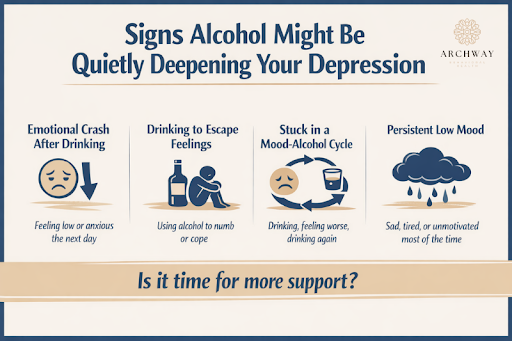
Notice the Emotional “Drop” After Drinking
A drink can feel relaxing in the moment.
But later? The emotional cost sometimes shows up quietly.
You might notice:
- A wave of sadness the next morning
- Irritability that feels out of proportion
- Anxiety creeping in for no clear reason
- A sense of heaviness or emptiness that wasn’t there before
Alcohol affects brain chemicals tied to mood regulation. So the temporary lift can sometimes be followed by a deeper emotional dip.
If this pattern repeats often, it may be your mind’s way of saying something needs attention.
Pay Attention to How You’re Using Alcohol
Many sober-curious people start noticing why they reach for a drink.
Maybe it’s:
- To soften the edge of a hard day
- To quiet racing thoughts at night
- To make social situations feel easier
- To escape the weight of sadness for a few hours
None of these motivations mean something is “wrong” with you. They simply reveal that alcohol may be acting like emotional duct tape—covering something that deserves real care.
And duct tape, eventually, peels off.
Watch for the “Mood Loop”
One of the clearest signals appears in a repeating cycle:
- Feeling low, overwhelmed, or emotionally drained
- Drinking to take the edge off
- Feeling worse emotionally afterward
- Drinking again to escape the new wave of heaviness
This loop can sneak up on people who never thought of themselves as having a problem with alcohol.
It’s less about labels and more about noticing patterns that don’t feel good anymore.
Signs You Might Benefit From Structured Mental Health Support
You don’t have to wait until things fall apart to explore support.
Sometimes the signal is simply realizing that your emotional life feels harder than it should.
🚩 Signs You Might Be Experiencing More Than a Temporary Slump
- Your mood stays low most days, even when life is relatively stable
- Alcohol seems to intensify sadness, guilt, or hopelessness
- Motivation and energy feel harder to access
- You’ve tried cutting back on drinking, but the emotional struggles remain
- Friends or family have gently expressed concern
At this stage, many people begin exploring structured care options designed specifically for depression. These environments offer consistent support, therapeutic guidance, and space to understand the relationship between mood and behavior.
For individuals dealing with both mental health struggles and alcohol use patterns at the same time, integrated care—such as specialized treatment options in Dual Diagnosis—can help address both sides of the experience together.
Try a Short “Curiosity Pause” With Alcohol
You don’t have to commit to forever.
Sometimes a simple experiment reveals a lot.
Consider taking a few weeks away from alcohol and asking yourself:
- Does my mood stabilize?
- Do mornings feel clearer emotionally?
- Am I more connected to my real feelings instead of numbing them?
Many people are surprised by how much mental space opens up once alcohol is removed—even temporarily.
This isn’t about rules. It’s about information.
Remember: Feeling Better Is the Goal
Depression has a way of convincing people they just need to “push through.”
But mental health isn’t something you have to muscle through alone.
Sometimes the bravest moment isn’t quitting drinking.
It’s asking, “What kind of support would actually help me feel like myself again?”
That question alone can open the door to meaningful change.
Talk With Someone Who Understands
If alcohol and depression seem to be tangled together in your life, compassionate support can make the next steps clearer.
Call (888) 488-4103 or visit our depression treatment program services to learn more about our depression treatment program services in your area.
You don’t have to figure this out alone—and feeling better is possible.
