

There’s a moment some people don’t talk about.
You leave therapy feeling steady… and by lunchtime the next day, everything is unraveling again.
If that sounds familiar, it doesn’t mean you’re doing anything wrong. It might just mean your life right now needs more support than one hour can hold.
And that’s more common than you think.
The Space Between Sessions Can Feel Too Long
Weekly therapy works for many people. But not everyone is in a place where insight alone is enough.
Sometimes the gap between sessions becomes the hardest part.
You remember what you talked about. You even agree with it.
But then real life shows up—stress, triggers, emotions that don’t wait for your next appointment.
And suddenly, it’s like trying to carry water in your hands. It slips through before you can use it.
Progress Doesn’t Always Happen in 60-Minute Increments
Healing isn’t neat. It doesn’t follow a calendar.
For some alumni—especially after a setback or relapse—there’s this quiet pressure to “get back on track” quickly. To prove that everything you learned still works.
But sometimes, the truth is heavier:
You don’t need more willpower.
You need more support, more often.
That’s not regression. That’s awareness.
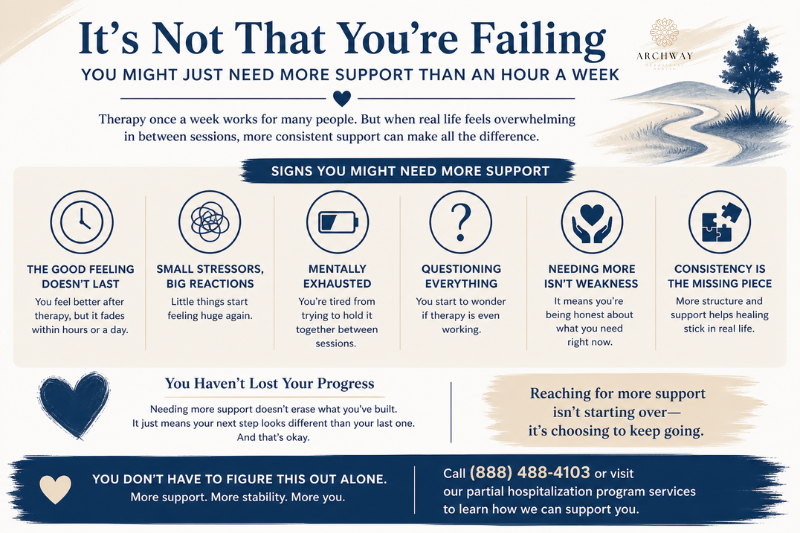
What It Can Look Like When You Need More Than Weekly Therapy
It’s not always dramatic. In fact, it’s usually subtle.
🚩 You might notice:
- You feel grounded right after therapy, but it fades within hours or a day
- Small stressors start triggering big emotional reactions again
- You’re mentally exhausted from trying to “hold it together” between sessions
- You start questioning if therapy is even working
That last one can hit hard.
Because the truth isn’t that therapy isn’t working.
It’s that the dose of support might not match what you’re carrying right now.
More Support Doesn’t Mean Something Is Wrong With You
There’s a quiet stigma around needing higher levels of care.
People think:
“If I need more than weekly therapy, things must be really bad.”
But that’s not how this works.
Needing more structured, consistent support often means:
- You’re paying attention
- You’re being honest about your limits
- You’re choosing stability over survival mode
That’s not failure. That’s self-awareness in action.
The Missing Piece Is Often Consistency, Not Effort
A lot of people try to “white-knuckle” their way between sessions.
They journal more.
They reread notes.
They try to apply coping skills perfectly.
And still… something doesn’t stick.
Because healing—especially after a relapse or emotional setback—often needs repetition in real time. Not just reflection once a week.
That’s where more structured daytime care can change things.
Not by overwhelming you, but by meeting you where you actually are, day to day.
If you’ve ever felt like when therapy isn’t enough, it’s usually not about effort—it’s about support matching intensity.
You’re Allowed to Need More Right Now
There’s nothing weak about saying,
“I can’t keep doing this on my own between sessions.”
There’s actually something steady in it.
Because the people who come back—who reach for more support instead of disappearing—are often the ones who build something stronger the second time around.
Not perfect. Just more supported.
Sometimes It’s Not Just One Thing
For some people, the struggle isn’t just emotional—it’s layered.
Mental health challenges can overlap in ways that make weekly therapy feel even less sufficient. If you’re navigating multiple symptoms at once, finding the right kind of support in Dual Diagnosis can make a meaningful difference.
You don’t have to sort it all out alone.
You Haven’t Lost Your Progress
It can feel like you’ve undone everything.
But needing more support doesn’t erase what you’ve already built.
It just means your next step looks different than your last one.
And that’s okay.
If things have been feeling harder to hold together lately, there are options that meet you with more consistency and care.
Call (888) 488-4103 or explore our partial hospitalization program services to learn more about how we support people who need more than once-a-week care right now.
