

It starts with a quiet question: “What if I don’t want to live like this anymore, but I’m not sure I’m ‘bad enough’ for treatment?”
If you’re beginning to wonder about your relationship with alcohol or substances, and the growing sense of dissatisfaction with your life, you’re not alone. Depression and addiction often co-occur, well before you’re at “rock bottom.”
At Archway Behavioral Health, we offer a professional depression treatment program that also addresses substance use. Located in Boca Raton, Florida, we meet you right where you are: curious, hurting, and ready for something better.
You Don’t Have to Be Diagnosed to Be Struggling
You might not have a formal diagnosis. You might not identify as an “addict.” That’s okay.
Depression and substance use often overlap long before either one is severe enough to trigger alarms. Maybe you drink more when you feel numb. Maybe you’ve noticed that hangovers hit harder, or your motivation disappears completely the next day. These patterns don’t make you broken. They make you human, and help is available.
Why Depression and Addiction Often Travel Together
Depression doesn’t just make you sad; it drains your energy, isolates you, and blurs your sense of self. Substances can feel like a shortcut back to joy, connection, or rest. But over time, they take more than they give.
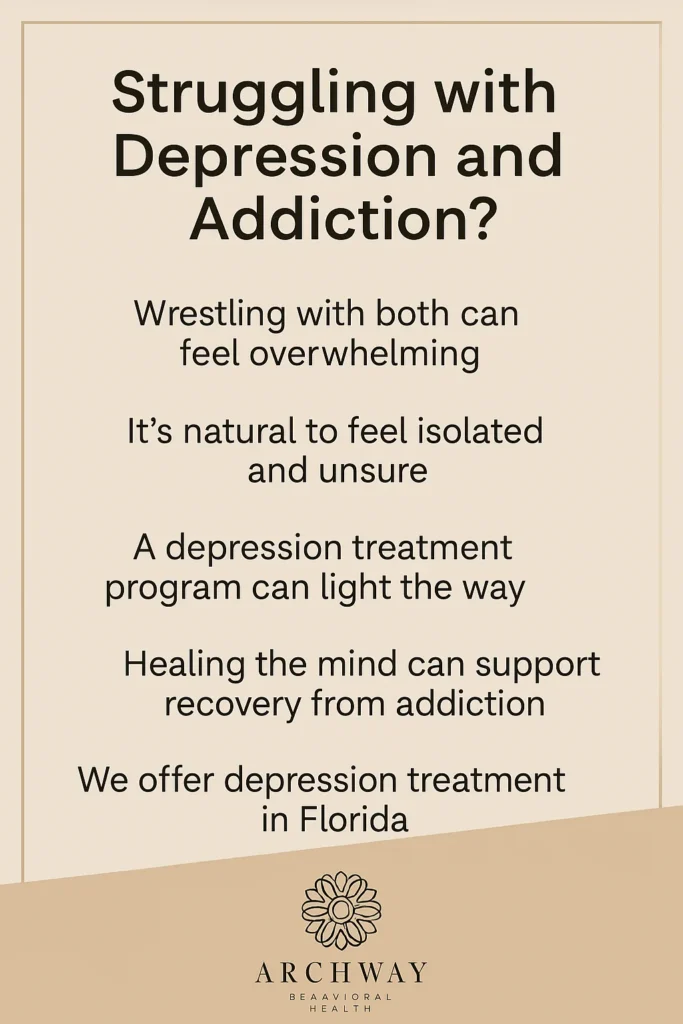
Here’s the science: the same brain systems affected by depression are often impacted by alcohol and drug use. When untreated, one condition can quietly reinforce the other. That’s why our program is built to treat both. We provide a treatment plan tailored to you, without shame, labels, or pressure.
What a Depression Treatment Program Actually Looks Like
Forget the stereotypes. At Archway, our depression treatment program isn’t about “fixing” you; it’s about understanding who you are and where you are on your treatment and recovery journey. We offer:
- Therapeutic support from licensed mental health professionals
- Dual diagnosis care for clients with both depression and substance use concerns
- Trauma-informed approaches that explore the why behind your feelings
- Optional group support that never pressures you to conform
Whether you’re stepping back from alcohol, processing burnout, or trying to make sense of your mood swings, there’s a space here for you.
Small Changes That Can Create Massive Shifts
In treatment, we focus on small, sustainable steps. This might include:
- Learning how your brain and body respond to stress
- Building new habits that support emotional stability
- Exploring what a “sober-curious” life could look like for you
- Healing relationships that matter—starting with the one you have with yourself
We don’t expect you to have it all figured out. We just want you to know you don’t have to do it alone.
A Local Resource for Real Change
If you’re in South Florida, you’re not far from the care you deserve. We work with individuals from across Palm Beach and Broward Counties. If you’re looking for a depression treatment program in Highland Beach, Delray Beach, or Deerfield Beach, Florida, look no further.
Our Boca Raton center is easily accessible—and intentionally designed to feel like a refuge, not a facility.
Don’t Wait for Rock Bottom to Get Help—Reach Out Today
Let’s be clear: there’s no minimum suffering required to deserve support.
If your mental health feels unstable, if you’re using substances more than you’d like, or if you’re just exhausted from trying to manage both, Archway Behavioral Health can help.
Call (888) 530-0227 or reach out online to learn more about our depression treatment program services in Boca Raton, Florida. Don’t wait to start healing.
