

Ninety days can change a lot.
I’ve sat with people who made it through those first difficult months. They rebuilt routines. Repaired relationships. Started sleeping better. Felt hope return in small, meaningful ways.
Then something happened.
A bad week became a bad month. Depression crept back in. Isolation returned. Maybe alcohol or drugs entered the picture again. Maybe they didn’t. But either way, life started feeling heavier than it had in a long time.
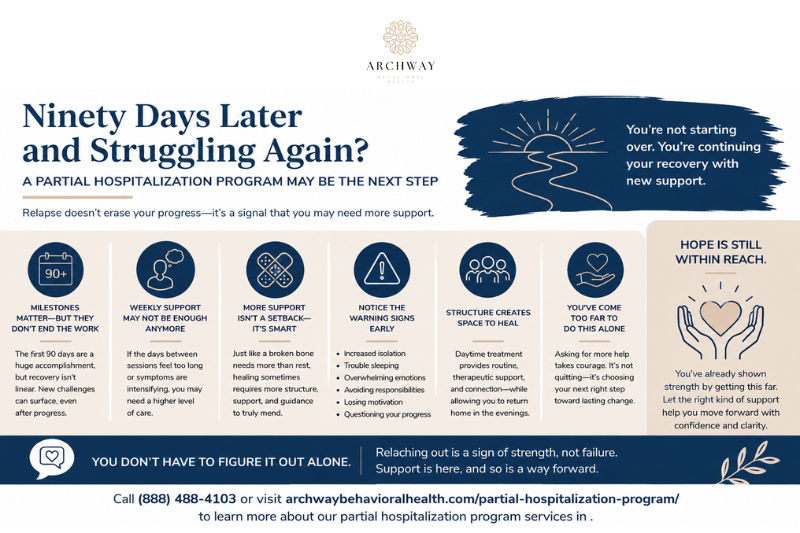
If that’s where you are, I want you to hear this: struggling again after 90 days does not mean you failed.
For many people, it’s a sign that they need a different level of support, not less. That’s why some alumni eventually explore a structured daytime treatment option when weekly therapy and occasional check-ins no longer feel like enough.
The Part No One Talks About After the Milestone
Ninety days is often celebrated. And it should be.
But recovery and mental health don’t suddenly become easy because a certain number appears on a calendar.
I’ve watched people reach 90 days and feel surprised by what comes next. The adrenaline of early recovery fades. Friends assume you’re doing better. Life expects you to keep moving forward.
Meanwhile, depression may still be there.
Anxiety may still be there.
The grief, trauma, loneliness, or emotional exhaustion that existed before treatment may still be asking for attention.
Sometimes people think, “I should be past this by now.”
That thought alone can keep someone suffering in silence.
When Weekly Support Starts Feeling Too Small
One conversation I hear often sounds something like this:
“I go to therapy. I’m taking the steps. Why does it still feel like I’m barely holding on?”
That’s not a sign of weakness.
It’s often a sign that your needs have changed.
There are seasons where one therapy session each week provides enough support. There are other seasons where symptoms become more intense, daily functioning starts slipping, and the space between appointments feels too long.
Some people even begin searching phrases like therapy not working depression because they can’t understand why they’re still struggling despite making an effort.
The reality is that treatment isn’t one-size-fits-all.
Sometimes the issue isn’t that therapy failed. It’s that your current level of care no longer matches what you’re carrying.
A Broken Bone Wouldn’t Heal Faster With Less Support
Imagine breaking your leg.
You wouldn’t remove the cast early because you had already worn it for three months.
You wouldn’t skip physical therapy because you wished you were stronger.
Mental health works similarly.
There are times when additional support isn’t a step backward. It’s part of the healing process.
I often tell alumni that needing more help is not evidence that they aren’t trying hard enough. It’s evidence that they’re paying attention.
That distinction matters.
The Quiet Warning Signs I Encourage People to Notice
Many alumni wait until they’re in crisis before asking for more support.
Often, the warning signs appear much earlier:
- You’re spending more time isolated than connected.
- Getting out of bed feels harder every week.
- You’re missing work, school, or responsibilities.
- Small problems feel overwhelming.
- You find yourself withdrawing from recovery supports.
- Depression feels heavier despite your efforts.
- You’re beginning to wonder if treatment helped at all.
None of these signs automatically mean you’re headed for disaster.
But they may suggest that a more structured environment could help interrupt the pattern before it deepens.
Why More Structure Can Feel Like Relief
People sometimes imagine higher levels of care as punishment.
What I often see is relief.
Relief from trying to manage everything alone.
Relief from waiting seven days between appointments.
Relief from carrying a backpack full of bricks and finally being allowed to set it down for a while.
Structured daytime care creates more opportunities to practice coping skills, process emotions, and reconnect with support while still returning home at the end of the day.
For individuals facing both mental health concerns and substance use challenges, additional help in Dual Diagnosis can also provide a more complete path forward.
Your Last Chapter Doesn’t Have to Define the Next One
The people who eventually find stability aren’t always the people who never struggle.
Often, they’re the people who respond differently when struggle returns.
They reach out sooner.
They stay curious instead of condemning themselves.
They allow themselves to receive support before things completely fall apart.
If you’ve been telling yourself that you should be able to handle this alone by now, I encourage you to question that assumption.
Sometimes strength looks less like pushing through and more like raising your hand.
The fact that you’re struggling today does not erase the progress you’ve already made.
It doesn’t cancel the work.
It doesn’t make the last 90 days meaningless.
And it certainly doesn’t mean you’re out of options.
If concerns such as severe mood changes, confusion, or symptoms connected to serious mental health conditions are becoming harder to manage, seeking specialized support in Psychotic Disorder treatment may also be an important step.
Call (888) 488-4103 or visit our partial hospitalization program services to learn more about our partial hospitalization program services in .
