

I almost didn’t come back.
Not because I didn’t need help—but because I was convinced I had already used up my chance.
I kept thinking, If it didn’t stick the first time, what’s the point?
But going back didn’t mean I failed. It meant I wasn’t done yet.
And that changed everything.
The Quiet Kind of Relapse No One Talks About
It wasn’t dramatic.
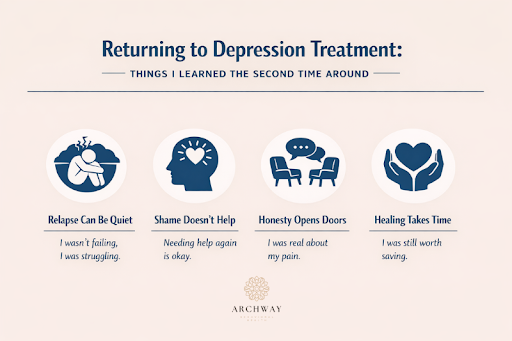
No breakdown. No obvious crash. Just a slow slipping back into old patterns—canceling plans, sleeping too much, ignoring texts, telling myself I’d “snap out of it.”
From the outside, it probably looked like I was just tired.
Inside, it felt like I was disappearing again.
That’s the part people don’t always say out loud—depression doesn’t always come back loudly. Sometimes it just quietly takes your life back piece by piece.
The Shame That Almost Kept Me Away
I didn’t want to return because I thought I’d be judged.
By the staff. By other people. Even by myself.
I kept hearing this voice: You already had help. You should know how to handle this.
But depression doesn’t care how much you “should” know.
And healing isn’t something you complete once and never revisit.
Walking back in felt like admitting defeat.
What it actually was… was choosing not to stay stuck.
What Changed the Second Time Around
The biggest difference?
I stopped pretending I was “fine enough.”
The first time, I kept parts of myself guarded. I didn’t always say how bad it really felt. I thought if I just followed the steps, I’d get better.
The second time, I showed up honest. Messy. Tired.
And that’s where things actually started to shift.
I learned there are different outpatient depression treatment options, and not all of them look the same—or work the same—for everyone. Some offered more structure during the day without needing to stay overnight. Others gave me space to rebuild slowly while still living my life.
That flexibility mattered more than I expected.
If you’re trying to figure out what kind of support actually fits, this breakdown of depression treatment program services helped me understand I wasn’t limited to just one path.
You’re Allowed to Need Help Again
This was the hardest thing for me to accept.
I thought needing help again meant I didn’t try hard enough the first time.
But that’s not how this works.
Depression isn’t a test you pass or fail.
It’s something you learn to navigate—with support, over time.
“I thought going back would feel like starting over. It didn’t. It felt like picking up where I left off—but stronger.”
— Former client
Going back didn’t erase my progress.
It gave it somewhere to grow.
The Moment I Realized I Was Still Worth Saving
It wasn’t during a breakthrough session.
It was a small moment—sitting in a group, listening to someone describe exactly how I felt, word for word.
For the first time in weeks, I didn’t feel alone in it.
That’s when it clicked:
I hadn’t failed. I had just lost my footing.
And I was allowed to find it again.
If You’re Hesitating Like I Did
I get it.
The second-guessing. The embarrassment. The voice telling you to just push through it on your own this time.
But if something in you is even quietly wondering if you need support again… that voice matters.
Especially if your depression is tangled with other things—like anxiety, trauma, or moments that feel harder to explain—it might help to look into more layered care, like care in Dual Diagnosis. You don’t have to sort everything out alone before asking for help.
You’re allowed to come back.
Coming Back Wasn’t the End of My Story
It was the part where I stopped trying to survive quietly and started actually healing.
Not perfectly. Not all at once.
But honestly.
And that made all the difference.
If this feels familiar—even a little—you don’t have to wait until things get worse to reach out.
Call (888) 488-4103 or visit our depression treatment program services to learn more about our depression treatment program services in Boca Raton.
