

You’re still showing up. Work gets done. People rely on you.
But behind all of that… something’s slipping.
And now you’re here—quietly searching, trying to figure out if getting help means losing everything you’ve built.
Early on, most people land on some version of this page—not because they’re ready to commit, but because they’re trying to understand what’s even possible.
You’re Not Falling Apart—You’re Burning Out Quietly
No one would guess.
You’re the reliable one. The one who answers emails, makes meetings, keeps things moving. But the cost of holding that image together is getting heavier.
It shows up in small ways:
- You need more to take the edge off
- Sleep isn’t really sleep anymore
- Your patience is thinner than you’d like to admit
You’re not crashing. You’re eroding.
And that’s exactly why this decision feels so complicated.
The Fear Isn’t Treatment—It’s Losing Control
Let’s say it plainly:
You’re not scared of getting help. You’re scared of what it might take away.
Your job.
Your routine.
Your identity as “the one who handles things.”
The idea of stepping into live-in treatment—being gone, unreachable, out of your normal life—feels impossible.
So your brain does what it does best:
“Maybe it’s not that bad yet.”
But here’s the tension you’re sitting in:
You need support.
You just can’t disappear to get it.
There Is a Middle Ground—And Most People Don’t Realize It
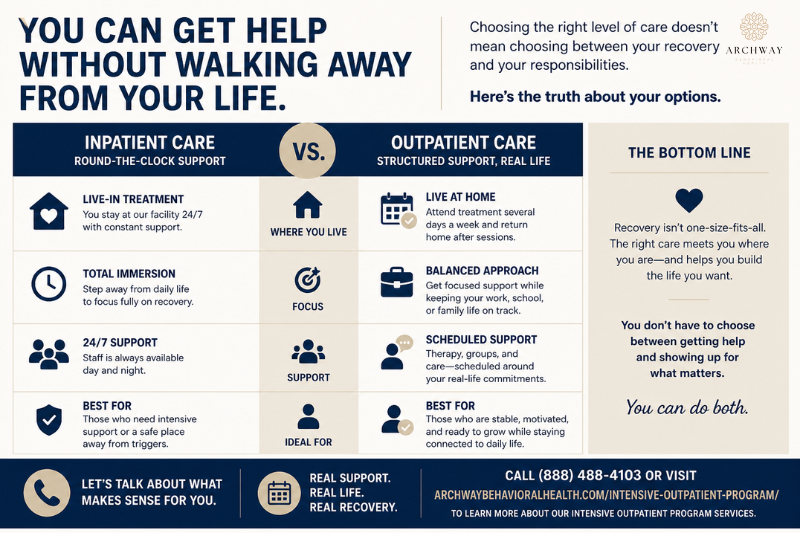
Not all treatment requires you to hit pause on your entire life.
Some people need round-the-clock support. That’s real, and it matters.
But others? They need structure, accountability, and a place to actually deal with what’s going on—without abandoning their responsibilities.
That’s where multi-day weekly treatment comes in.
It’s not passive. It’s not “light.”
It’s focused, consistent care that fits around real life.
You show up. You do the work.
And then you go home—and start applying it immediately.
Why High-Functioning People Often Choose This Path
This isn’t about choosing the “easier” option.
It’s about choosing the right level of care for where you are.
If you’re still managing your day-to-day life—but barely holding it together internally—this kind of structure can meet you without ripping everything away.
Here’s what we see all the time:
- Professionals who can’t step away from work completely
- Parents who need to stay present at home
- People who don’t need detox or 24/7 monitoring—but do need real support
You don’t have to prove how bad things are to deserve help.
The Real Question Isn’t “Which One Is Better?”
It’s this:
What level of support do you actually need—and what are you willing to keep carrying alone?
That’s the honest version of the outpatient vs inpatient rehab conversation.
Not which one sounds more serious.
Not which one other people expect.
But which one gives you enough support to change something without collapsing your entire life in the process.
For many high-functioning people, that answer becomes clear once they stop trying to “tough it out.”
If Mental Health Is Part of This, It Matters More Than You Think
Sometimes it’s not just about substance use.
Sometimes it’s anxiety that won’t turn off.
Or depression that you’ve learned to work around.
Or moments where things feel… off in ways you can’t explain.
When mental health and substance use collide, it changes what kind of support actually works.
That’s why some people also explore treatment options in Dual Diagnosis—because treating one without the other rarely sticks.
You don’t have to figure all of that out on your own. But ignoring it usually makes things harder.
You Don’t Have to Blow Up Your Life to Start Fixing It
There’s a quiet myth that getting help has to be extreme.
That it only “counts” if everything stops.
But most of the people we work with?
They didn’t need to disappear.
They just needed a place where they could finally be honest—and a structure that didn’t let them keep avoiding it.
That’s what this level of care is for.
If you’ve been holding it together longer than you should have… this is your permission to stop doing it alone.
Call (888) 488-4103 or explore our intensive outpatient program services to learn more about what support can actually look like—without walking away from your life.
