

You didn’t quit your job. You didn’t disappear for 30 days.
And somehow… things started getting shaky again.
If you’ve been trying to hold it together while working full-time, this isn’t a failure story. It’s a common one. And there’s still a way forward—without putting your entire life on pause.
If you’ve been looking into options like intensive outpatient support but aren’t sure how it fits into real life, this is where we start.
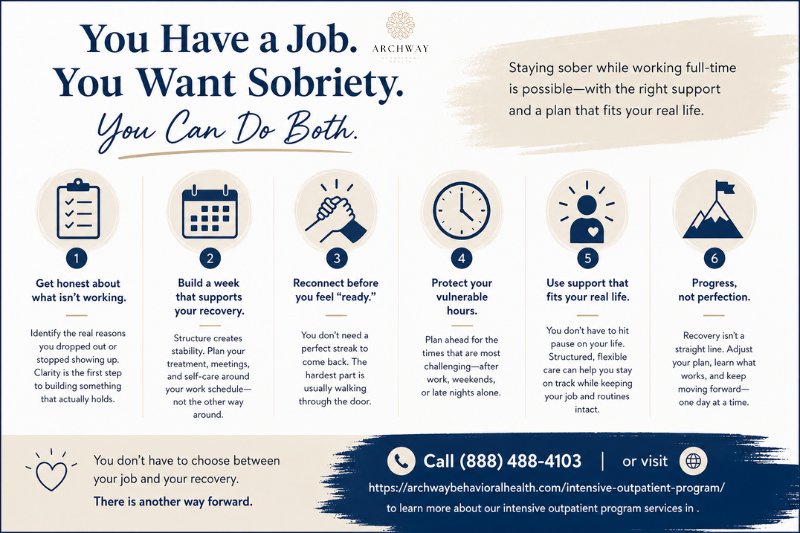
Start With What Actually Fell Apart (Not What “Should” Work)
A lot of people don’t drop out because they don’t care.
They drop out because something didn’t fit.
Maybe the schedule clashed with work.
Maybe the emotional weight hit harder than expected.
Maybe showing up started to feel like exposure instead of support.
Before trying again, get honest about what didn’t work. Not in a blaming way—just in a clear one.
Because staying sober without inpatient rehab isn’t about trying harder.
It’s about building something that actually holds.
Build a Week That Supports You (Even If It’s Not Perfect)
Sobriety doesn’t live in big decisions. It lives in Tuesdays at 7pm.
It lives in what happens after work, when your brain is tired and old habits feel close.
You don’t need a perfect routine. You need a repeatable one.
That might look like:
- Two or three structured sessions during the week
- One standing commitment (meeting, therapy, group) you don’t cancel
- A planned “after work” buffer before going home
Think of it less like discipline, more like scaffolding. Something to lean on until you feel stronger again.
Don’t Wait to “Feel Ready” to Reconnect
This part trips people up.
There’s often a quiet thought:
“I should get a few days clean first… then I’ll go back.”
But that delay can stretch into weeks.
If you left a program or stopped showing up, you’re still allowed to come back.
No speech required. No explanation needed on day one.
Most people who return say the same thing:
“It wasn’t nearly as awkward as I thought it would be.”
Protect the Hours That Tend to Go Sideways
Not every hour is equally risky.
For a lot of working adults, it’s:
- Right after clocking out
- Late evenings alone
- Weekends without structure
Instead of trying to “be strong” during those times, plan around them.
That might mean:
- Scheduling something immediately after work
- Not being alone during certain windows
- Having one person you can text without overthinking it
You don’t need to control your whole life.
Just the hours that matter most right now.
Let Your Life Stay Intact While You Get Better
One of the biggest fears is losing everything—your job, your routine, your identity.
That’s why many people try to figure out how to stay sober without inpatient rehab in the first place.
And in many cases, it’s possible.
Structured, multi-day weekly care exists specifically for people who can’t step away completely—but still need real support. Not surface-level help. Not once-a-week check-ins. Something in between.
If your mental health and substance use have started overlapping, it may also help to explore treatment options in dual diagnosis—especially if stress, anxiety, or burnout are part of the cycle.
You’re Not Starting Over—You’re Adjusting the Plan
Stopping and restarting doesn’t erase what you’ve already learned.
It just means the original setup didn’t match your life.
And honestly? That’s useful information.
You’re allowed to come back differently this time:
- With a schedule that fits
- With fewer expectations
- With more honesty about what you need
No reset button required.
A Few Quick Anchors to Keep You Steady
If things feel shaky this week, start here:
- Pick one commitment you’ll keep, no matter what
- Tell one person the truth about where you’re at
- Don’t isolate during your hardest hour of the day
- Make your next step small enough that you’ll actually do it
That’s enough for now.
You Don’t Have to Disappear to Get Better
There’s a version of recovery that doesn’t require leaving your job or stepping away from your life completely.
It just requires the right level of support—and a structure that meets you where you are right now.
If you’ve been trying to hold it together quietly, you don’t have to keep doing it alone.
Call (888) 488-4103 or visit our intensive outpatient program services to learn more about our intensive outpatient program services in Boca Raton.
