

The moment a parent realizes their child is struggling again can feel like the ground shifting beneath them.
Maybe you’ve tried everything already—therapy, boundaries, long talks at the kitchen table. And still, something in your 20-year-old’s life seems to be slipping.
Families often reach this moment quietly. Not with a crisis, but with a question: What do we do now?
For many, the next step involves exploring a structured form of care like a depression treatment program—not because anyone failed, but because healing sometimes needs more support than a family can carry alone.
The Moment Parents Realize This Isn’t Just a Phase
Parents often describe a slow realization.
Your child seems withdrawn. Sleep patterns flip. Motivation disappears. The person you raised—the one who used to laugh easily—feels distant.
You might hear things like:
- “I’m just tired all the time.”
- “Nothing really matters.”
- “I’ll figure it out.”
But deep down, something doesn’t feel temporary anymore.
Depression in young adults rarely looks dramatic. It looks like stalled life—missed classes, unfinished plans, quiet rooms, and parents lying awake wondering what they missed.
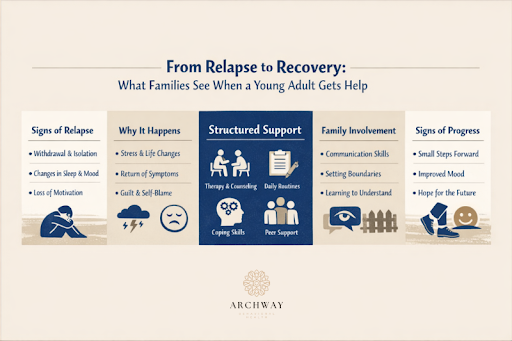
Why Relapse in Mental Health Can Happen
Relapse isn’t failure. It’s often part of the reality of mental health recovery.
Young adulthood is one of the most emotionally demanding periods of life. Identity, relationships, independence, pressure to succeed—it all lands at once.
Sometimes early treatment helped for a while. Then stress returned. Or symptoms quietly crept back.
Families often blame themselves in these moments.
But depression doesn’t return because parents didn’t care enough. It returns because mental health conditions can ebb and flow, especially during big life transitions.
What matters most is what happens next.
What Structured Support Changes for Young Adults
When a young adult enters a structured care environment, the biggest shift is simple: they’re no longer trying to manage everything alone.
Instead of one therapy appointment a week, they receive consistent support throughout the week.
That can include:
- Regular therapy and psychiatric support
- Skills for managing overwhelming thoughts
- Structured daily routines that rebuild stability
- Peer support from others facing similar struggles
It creates something many young adults secretly need but struggle to ask for—a reset.
Not a punishment. Not a failure.
A place to stabilize and rebuild.
The Role Families Play in Healing
Parents are often surprised by how much their presence still matters.
Even when your child is technically an adult, your steady support can make a powerful difference.
Families are often invited to participate in parts of the recovery process. This might involve learning:
- How to communicate without escalating conflict
- How to set healthy boundaries without abandoning support
- How to recognize early warning signs moving forward
Sometimes families also discover that depression is tangled with other challenges. In some cases, programs may help families explore options for things like treatment in Boca Raton when mental health struggles overlap with other concerns.
The goal isn’t to assign blame. It’s to strengthen the support system around the young person.
What Parents Often Feel During This Process
Parents rarely say it out loud, but many carry a quiet fear:
“Did I miss something?”
Guilt has a way of showing up in these moments.
But here’s something clinicians see again and again: the parents who ask that question are almost always the ones who have been trying the hardest.
Your love did not cause your child’s depression.
And your willingness to keep looking for help—even after setbacks—often becomes one of the strongest parts of their recovery story.
Recovery Rarely Looks the Way People Expect
Families often expect a dramatic turning point.
In reality, recovery tends to look quieter.
A young adult gets out of bed a little earlier.
They answer a text message.
They start imagining a future again.
Progress in mental health is often measured in inches, not miles.
But those inches add up.
And over time, they can rebuild a life that once felt impossible.
There Is Still a Way Forward
If your child is struggling again, it doesn’t erase the progress they’ve made—or the love you’ve given them.
It simply means the path needs more support right now.
A compassionate depression treatment program can help young adults regain stability while guiding families through the uncertainty that often comes with relapse.
Call (888) 488-4103 or visit our depression treatment program services to learn more about our depression treatment program services.
And if you’re reading this as a worried parent tonight, know this: hope often begins the moment families stop trying to carry everything alone.
