

You didn’t “fail.”
You paused. You disappeared. Maybe you spiraled a little. Maybe you just got tired.
If you’ve been thinking about returning to an intensive outpatient program, but the shame feels louder than the hope — this is for you.
I’ve been there. The awkward silence. The unanswered texts. The story in your head that says, They probably don’t want me back.
Let’s talk about how to walk back in like you never left.
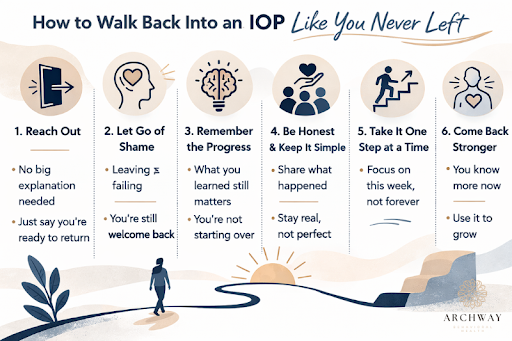
1. Drop the “I Have to Explain Everything” Story
You do not owe a perfect explanation.
You don’t need a speech.
You don’t need a PowerPoint on your relapse.
You don’t need to justify why you ghosted.
Most programs especially ones that understand real recovery, expect bumps. They’ve seen it before. The door is usually a lot more open than your anxiety is telling you.
Sometimes all it takes is:
“Hey. I’d like to come back.”
That’s it.
2. Remember: Leaving Doesn’t Erase the Work You Did
Just because you stopped showing up doesn’t mean the growth vanished.
You still learned things.
You still built insight.
You still had honest moments.
Relapse or avoidance doesn’t cancel progress. It complicates it. That’s different.
I once heard someone say, “Recovery isn’t erased, it just gets dusty.” That stuck with me.
You’re not starting from zero. You’re starting from experience.
3. Expect Some Discomfort But Not a Firing Squad
Yes, it might feel awkward the first day back.
You might wonder:
- Are they judging me?
- Do they think I’m not serious?
- Did I waste everyone’s time?
Here’s what’s more likely true:
They’re glad you’re alive.
They’re relieved you came back.
They know this is hard.
Good multi-day weekly treatment programs understand that people sometimes disappear when things get overwhelming. That’s not defiance. That’s being human.
4. Reach Out Before You Feel “Ready”
This is the spicy part.
If you wait until you feel fully ready, fully motivated, fully stable… you might wait forever.
Sometimes you go back because you’re not okay.
Because things are sliding again.
Because you don’t trust your own momentum right now.
And that’s allowed.
You don’t have to earn your way back by suffering first.
5. Be Honest About What Happened (But Keep It Simple)
When you do talk to someone, an intake coordinator, a therapist, a group facilitator, you don’t need a dramatic confession.
Just be real.
“I got overwhelmed.”
“I started using again.”
“I thought I could handle it alone.”
“I didn’t want to disappoint anyone.”
That kind of honesty goes a long way.
If what pulled you out was related to when mental health and substance use collide, it may be worth asking about specialized care in Dual Diagnosis so both sides of the struggle are supported together.
Because sometimes the issue wasn’t willpower.
It was untreated anxiety. Or depression. Or something heavier.
6. Let This Version of You Be Different
You’re not the same person who first walked in.
Now you know what it feels like to leave.
You know what unstructured days can turn into.
You know where your edges are.
That awareness? It’s powerful.
Coming back to an intensive outpatient program after a gap isn’t about pretending nothing happened. It’s about using what happened.
There’s strength in returning.
7. Stay for the Next Right Step, Not Forever
You don’t have to commit to a lifetime.
Just commit to showing up this week.
Sometimes people leave because the whole process feels overwhelming. But structured daytime care isn’t a life sentence, it’s a support system while you stabilize.
If symptoms like paranoia, disorganized thinking, or severe mood swings were part of why things unraveled, it may help to explore targeted help in Psychotic Disorder alongside your regular programming.
The goal isn’t perfection.
It’s steadiness.
One Honest Truth
Most people who return after ghosting say the same thing:
“It was way less dramatic than I thought it would be.”
The shame is loud in your head.
In real life, it’s usually just paperwork and a welcome back.
If you’ve been hovering over the phone, rehearsing what to say, this might be your sign.
You are not disqualified from support because you left. You’re human.
Call (888) 488-4103 or visit our intensive outpatient program services to learn more about our intensive outpatient program services in .
You don’t have to explain everything.
You just have to walk back in.
