
You’ve always felt everything.
The joy hits big. The heartbreak hits bigger. You’re the expressive one, the passionate one, the person people call “intense” sometimes lovingly, sometimes not.
And somewhere along the way, anxiety wrapped itself around all of that. Now you’re wondering: If I get help… will I lose the best parts of me too?
As a clinician, I hear this fear more than you might think.
“What If I Get Boring?”
Many high-emotion personalities live with a quiet belief:
My edge is my anxiety.
My creativity comes from the chaos.
If I calm down, I’ll flatten out.
It makes sense that you’d be protective.
When your emotions are vivid, they can feel like fuel. They’ve helped you create, connect, perform, and survive. The thought of softening them can feel like erasing yourself.
But here’s what I’ve seen over and over:
Anxiety isn’t your depth. It’s the static around it.
The Difference Between Intensity and Suffering
There’s a difference between feeling deeply and living in constant overdrive.
Intensity is:
- Crying at music because it moves you.
- Caring fiercely about people.
- Being animated, expressive, alive.
Anxiety is:
- Replaying conversations at 2 a.m.
- Living with a tight chest and a restless mind.
- Mistaking adrenaline for personality.
When someone explores anxiety treatment in Boca Raton, the goal isn’t to dim their personality.
It’s to reduce the suffering that’s been hijacking it.
You Are Not Your Nervous System
High-emotion people often have sensitive nervous systems. You notice more. You feel more. You react faster.
That sensitivity can be a gift.
But when your nervous system is constantly on high alert, it can blur the line between who you are and what your body is doing.
Treatment isn’t about changing your identity.
It’s about helping your body feel safe enough so your identity doesn’t have to be in fight-or-flight all the time.
What Actually Happens When Anxiety Softens
This is the part people rarely talk about.
When anxiety decreases, most creative, expressive clients don’t become flat.
They become clearer.
They still feel deeply — but without spiraling.
They still care — but without collapsing.
They still create — but without burning themselves out to do it.
One client once told me, “I thought I’d lose my fire. Turns out I just stopped setting myself on fire.”
That’s the difference.
When Mental Health and Substance Use Collide
For some high-emotion personalities, anxiety doesn’t travel alone.
It pairs with alcohol, stimulants, or other substances that temporarily heighten or numb feeling. It can feel like self-medicating your own intensity either turning the volume up or down.
When mental health and substance use collide, it often takes careful, integrated support. If that resonates, exploring options like support in Dual Diagnosis can help address both layers without judgment.
You deserve care that understands the full picture of you.
You Don’t Have to Choose Between Depth and Peace
This is the quiet truth:
You are not required to suffer in order to be interesting.
You are not required to be anxious in order to be creative.
You are not required to stay overwhelmed to stay yourself.
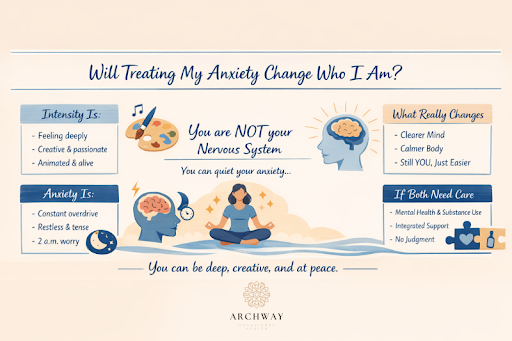
Real anxiety treatment doesn’t erase personality. It creates space, space for your humor, your passion, your tenderness without the constant undercurrent of dread.
And if you’re in Florida and wondering what that could look like, learning more about options for care can be a gentle first step toward steadier ground.
You don’t have to decide today who you’d be without anxiety.
You only have to be curious enough to imagine that you might still be fully, vividly you just breathing easier.
Call 888-488-4103 or visit our anxiety treatment services in Boca Raton to learn more about our anxiety treatment services in Boca Raton.
