

A few years ago, I honestly thought I was “past” needing treatment.
I’d already done the hard work once. I had stretches where life looked stable from the outside. I knew how to function. Smile in public. Push through workdays. Tell people I was just tired.
But depression has a quiet way of moving back in.
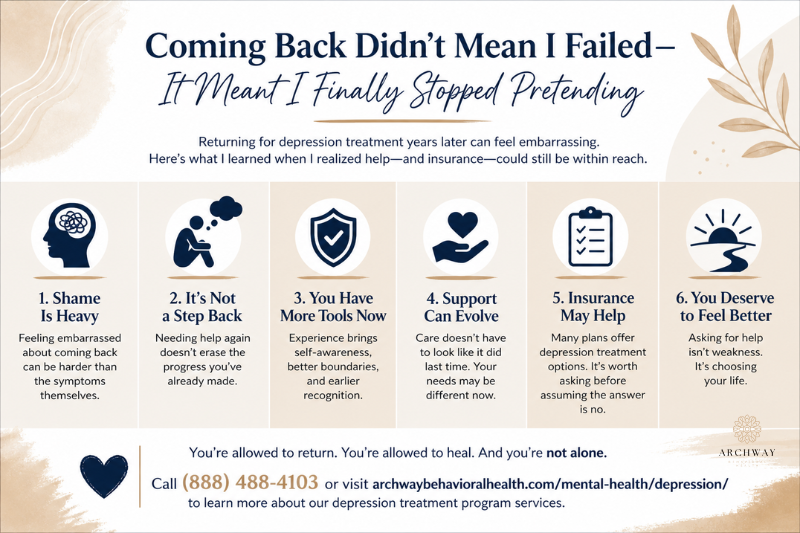
And one of the hardest parts about coming back wasn’t admitting I was struggling again. It was the shame of thinking I should’ve been able to handle it alone by now.
I also assumed treatment would be financially impossible. That belief kept me stuck longer than I want to admit. Then I learned more about depression treatment options and realized insurance may cover more support than I expected.
The Embarrassment Hit Harder Than the Symptoms Sometimes
Depression already makes you isolate. Returning for help years later can add another layer to it.
You start telling yourself things like:
- “I should know better by now.”
- “Other people moved on.”
- “They’ll think I failed.”
- “I already had my chance.”
The strange thing is, nobody at treatment said any of that to me.
Most of the shame was happening inside my own head.
I think a lot of long-term alumni quietly carry this fear that needing support again somehow erases the progress they already made. But emotional pain doesn’t work that way. A hard season doesn’t cancel the years you survived before it.
High-Functioning Depression Can Hide for a Long Time
I wasn’t falling apart publicly.
That almost made it worse.
I was still answering texts. Paying bills. Showing up to things late instead of not at all. From the outside, it looked manageable.
Inside, though, everything felt heavy. Like walking through wet cement while pretending it was fine.
Depression doesn’t always look dramatic. Sometimes it just slowly drains color from your life until even basic things feel emotionally expensive.
That’s part of why so many people delay returning to care. They convince themselves they’re “not bad enough yet.”
I Thought Insurance Would Say No
This was the excuse I leaned on the longest.
I assumed my previous treatment history would somehow disqualify me. Or that mental health support would cost so much it wasn’t realistic.
Instead of asking questions, I filled in the blanks myself.
What surprised me was learning that many people still have access to some form of depression treatment insurance coverage depending on their plan, clinical needs, and level of care. I didn’t know that because I never let myself look into it.
And honestly, depression loves certainty. Especially negative certainty.
“If I can’t afford it, there’s no point trying.”
That mindset kept me isolated far longer than the actual logistics did.
Coming Back Felt Different the Second Time
The first time I entered treatment, everything felt unfamiliar and chaotic.
Coming back years later felt quieter. More honest.
There was less pretending. Less trying to say the “right” thing. I understood my patterns better. I could recognize burnout earlier. I knew the difference between being exhausted and emotionally disconnected.
That doesn’t mean it was easy.
Walking back through those doors still felt vulnerable. But vulnerability is strange like that. Sometimes the thing that feels humiliating at first becomes the exact thing that reconnects you to yourself again.
“I thought going back meant I failed. It actually meant I stopped abandoning myself.”
– Former Alumni Client
Support Doesn’t Have to Look Like Starting Over
This matters.
Returning for help doesn’t always mean disappearing into a long-term program or rebuilding your life from scratch. Sometimes people benefit from structured daytime care. Others need therapy adjustments, medication support, or a consistent place to reconnect emotionally.
For some people, depression also overlaps with other mental health challenges that were never fully addressed the first time around. That’s why integrated support for help in Dual Diagnosis can matter more than people realize.
The important thing is this: support can evolve with you.
The Cost of Waiting Was Higher Than the Cost of Asking
Looking back, the biggest loss wasn’t financial.
It was time.
Time spent pretending I was okay. Time spent withdrawing from people I loved. Time spent believing exhaustion was just adulthood.
Depression can make your world smaller very slowly. So slowly you barely notice it happening.
Until one day you realize you haven’t felt fully present in your own life for a long time.
That realization hurt. But it also finally pushed me to reach out.
You’re Allowed to Return
There’s this unspoken belief that healing should happen once, perfectly, and forever.
Real life rarely works that way.
People grow. Life changes. Loss happens. Stress accumulates. Mental health shifts over time.
Needing support again doesn’t make you weak. It makes you human.
And if part of what’s stopping you is fear about cost or uncertainty around depression treatment insurance coverage, it may be worth asking questions before assuming the answer is no.
You don’t have to earn help by getting worse first.
Call (888) 488-4103 or visit Archway Behavioral Health’s depression treatment program services to learn more about available support options.
