

Some people picture depression as crying constantly or falling apart in obvious ways. But for a lot of people, it looks quieter than that.
It looks like staring at the ceiling at 7:12am while your alarm keeps going off.
It looks like calling out “sick” because the idea of answering emails feels physically painful.
It looks like thinking, “I know I need to move… so why can’t I?”
If that sounds familiar, you’re not lazy. And you’re not failing at adulthood.
For many people, this is what depression treatment support becomes about in the beginning—not dramatic breakdowns, but the slow loss of momentum, energy, and hope.
The Hardest Part Is Usually Invisible
People around you might still think you’re functioning.
Maybe you’re still showering sometimes. Maybe you still answer texts. Maybe you still show up to work often enough that nobody realizes how much effort it takes.
But inside, everything feels heavy.
Even simple tasks start to feel like lifting furniture with one hand tied behind your back. Getting dressed. Replying to messages. Making coffee. Opening your laptop.
The phrase can’t get out of bed depression exists for a reason. People search it because they’re trying to figure out whether what they’re experiencing is exhaustion, burnout, or something deeper.
And honestly? Sometimes it’s hard to tell at first.
Depression Doesn’t Always Feel Like Sadness
This surprises a lot of people.
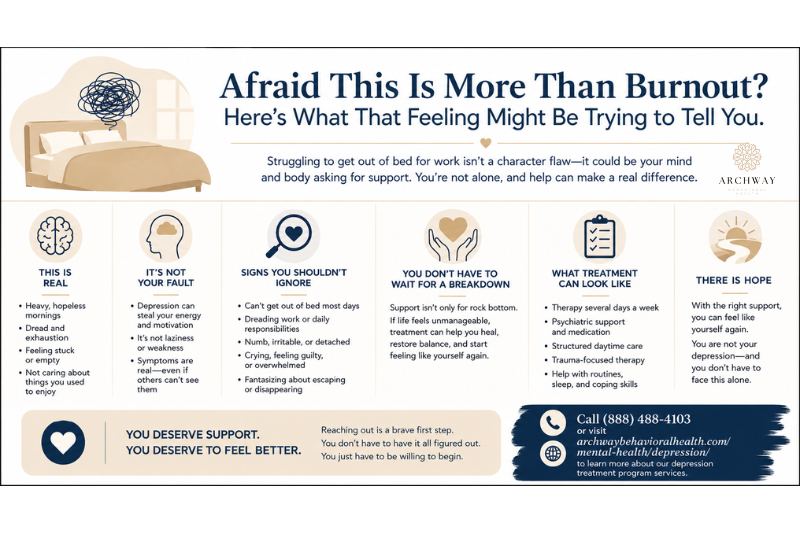
Depression can feel like:
- Numbness
- Irritability
- Mental fog
- Constant guilt
- Physical heaviness
- Emotional shutdown
- A weird inability to care about things you used to care about
Some people don’t even realize they’re depressed because they aren’t crying. They’re just… disconnected.
Like life has become something to survive instead of participate in.
One of the most painful parts is that your brain often starts turning this into a character flaw.
“You’re lazy.”
“You’re weak.”
“Other people do this every day.”
But depression has a way of distorting effort. Things that look “small” from the outside can require enormous energy internally.
You Don’t Have to Completely Fall Apart Before Getting Help
A lot of people wait until everything implodes.
Until they lose the job.
Until the relationship collapses.
Until they stop functioning entirely.
But mental health support isn’t reserved for people at rock bottom.
Sometimes the clearest sign that you need support is simply this:
You can’t keep living like this.
That matters.
If mornings have started feeling impossible, if dread follows you through the day, or if you feel emotionally underwater most of the time, it may be time to explore what treatment could look like.
Not punishment. Not being “fixed.”
Support.
What Treatment Often Looks Like in Real Life
People are often scared that treatment means losing control of their life overnight.
In reality, many depression programs are designed to meet people where they are.
That can include:
- Therapy several days a week
- Psychiatric support if medication might help
- Structured daytime care for people who need more stability
- Trauma-focused support
- Help rebuilding routines, sleep, and emotional regulation
Some people need a higher level of care for a while. Others benefit from multi-day weekly treatment while continuing parts of daily life.
There isn’t one “correct” level of struggle required to deserve help.
And if mental health symptoms are tangled together with substance use, emotional numbness, or self-medicating behaviors, support for when mental health and substance use collide can also help address the bigger picture.
A Small Sign You Shouldn’t Ignore
Here’s something clinicians hear all the time:
“I thought I was just tired.”
Not physically tired. Soul tired.
The kind of exhaustion that sleep doesn’t touch.
If you’ve started fantasizing about disappearing for a week just so you don’t have to perform being okay anymore, that’s worth paying attention to.
So is:
- Crying before work regularly
- Missing responsibilities because you feel frozen
- Struggling to care about consequences
- Feeling emotionally detached from your own life
- Spending most of the day trying to “push through” basic functioning
You do not need to wait for a crisis to count.
Needing Help Does Not Mean You’ve Failed
This part matters.
A lot of people think asking for treatment means they “couldn’t handle life.”
But depression is not a motivation problem solved by trying harder.
Sometimes the brain and body reach a point where support is necessary—just like any other health condition.
And treatment is not about becoming a different person.
It’s about feeling reachable to yourself again.
Like your own life isn’t happening behind glass.
For people dealing with more severe symptoms like paranoia, emotional disconnection, or reality disturbances alongside depression, specialized support in psychotic disorder care may also be important.
You’re Allowed to Take This Seriously
You don’t need permission to admit something feels wrong.
If getting out of bed for work has become a daily mental battle, your mind may be asking for care long before it knows how to ask out loud.
That doesn’t make you dramatic.
It makes you human.
Call (888) 488-4103 or visit our depression treatment program services to learn more about our depression treatment program services.
