

You’ve watched the shift happen slowly. Less motivation. More time alone. Things they used to care about… don’t seem to matter anymore.
And somewhere in the back of your mind, a question keeps circling: Is this just laziness—or something more?
If you’re here, you’re already paying attention in the way that matters most. And that’s where clarity can begin.
Early on, many parents turn to tools like an am i depressed quiz to get a clearer sense of what might be going on beneath the surface.
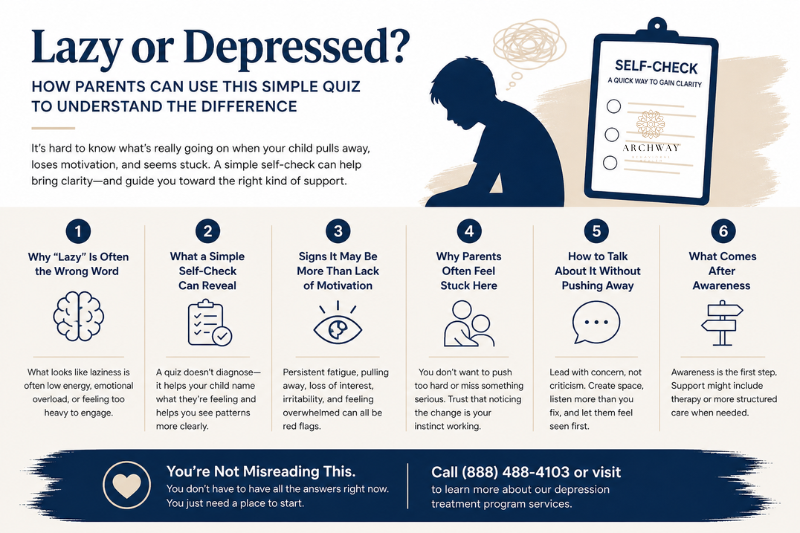
Why “Lazy” Is Often the Wrong Word
From a clinical perspective, true laziness is rare.
What looks like avoidance or lack of effort is often something else entirely—low energy, emotional shutdown, or a mind that feels too heavy to engage.
Depression doesn’t always look like sadness.
Sometimes it looks like:
- Not starting things
- Not finishing things
- Not caring about things that used to matter
To a parent, it can feel confusing. Even frustrating. But underneath it, there’s often a nervous system that’s overwhelmed—not unwilling.
What a Simple Self-Check Can Actually Reveal
A well-designed self-check or quiz isn’t meant to diagnose. It’s meant to slow things down and help someone notice patterns.
For your child, it can offer something subtle but powerful:
a way to put words to what they’re feeling—without pressure.
For you, it offers perspective.
Instead of asking, “Why aren’t they trying?”
It gently shifts the question to, “What might be getting in the way?”
That shift alone can change how conversations unfold at home.
🚩 Signs It May Be More Than Lack of Motivation
You might be noticing things that don’t quite fit the idea of “laziness.”
You might be seeing something deeper if:
- They seem tired no matter how much they sleep
- Small tasks feel overwhelming to them
- They withdraw from friends or family
- They’ve lost interest in things they used to enjoy
- Their mood feels flat, irritable, or distant
These aren’t character flaws. They’re signals.
And signals deserve attention—not judgment.
Why Parents Often Feel Stuck Here
This stage is one of the hardest.
You don’t want to overreact.
But you also don’t want to miss something serious.
Many parents find themselves walking a tightrope:
- If you push too hard, they shut down
- If you step back, things don’t improve
That tension can make you question your instincts.
But here’s the truth: noticing the change is the instinct.
You’re not imagining it.
How to Talk About It Without Pushing Them Away
You don’t need the perfect words. You just need a steady tone.
Try leading with observation instead of assumption:
- “I’ve noticed things feel harder for you lately.”
- “You don’t seem like yourself. I’m here if you want to talk.”
Avoid labeling it as laziness outright. That word tends to close doors.
Instead, create space.
Let them feel seen before they feel understood.
Sometimes that’s the moment they start to open up.
What Comes After Awareness
If a quiz or self-check points toward depression—or even if your gut says something isn’t right—the next step isn’t panic.
It’s support.
For some families, that might mean starting with therapy.
For others, it may involve more structured care—especially if daily functioning is being affected.
In certain situations, where mental health challenges overlap or become more complex, exploring treatment options in Dual Diagnosis can provide a more complete level of care.
The key is this: you don’t have to solve it alone.
You’re Not Misreading This
There’s a quiet moment many parents reach—where they realize:
This isn’t just a phase.
That moment can feel heavy. But it’s also the point where real help becomes possible.
You don’t need to have all the answers right now.
You just need a place to start.
Ready to Take the Next Step?
If you’re trying to understand what your child is going through and what kind of support might actually help, you’re not alone in this.
Call (888) 488-4103 or visit our depression treatment program services to learn more about how we support families through moments exactly like this.
