

He sat in my office in a tailored suit, answering emails between sentences.
“I’m just tired,” he said. “It’s not like I can’t function.”
He could function. That was the problem.
Within the first few minutes, I had already recommended he explore our depression treatment program. He looked at me like I’d just suggested he shut down his company for a weeklong spa retreat.
“I’m not that bad,” he said.
High-functioning people rarely think they are.
The Lie of “I’m Fine Because I’m Performing”
He was a senior executive. Married. Two kids. Never missed a board meeting.
But he hadn’t slept through the night in eight months.
He was short with his team.
He drank alone in his office after hours, not recklessly, just quietly.
From the outside, everything looked stable. From the inside, he described it as “white noise and dread.”
High-functioning depression doesn’t always collapse your life.
Sometimes it just drains the color out of it.
What High-Achievers Hide From Themselves
Here’s what he didn’t say at first:
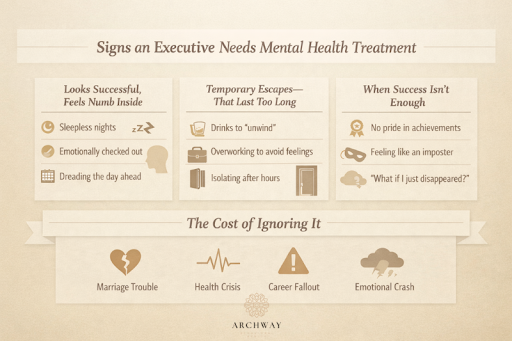
- He fantasized about disappearing—not dying, just being unreachable.
- He couldn’t remember the last time he felt proud of anything.
- He resented his own success.
- He was terrified someone would notice he felt like a fraud.
This isn’t laziness.
It isn’t weakness.
It’s a nervous system that’s been running on cortisol and performance for too long.
Executives are trained to override discomfort.
Depression doesn’t care about your title.
“I’m Not Drinking That Much” (And Other Negotiations)
He didn’t identify as someone with a substance problem.
He just needed something to “take the edge off.”
That edge was getting sharper.
When mental health and substance use collide, it complicates everything. We often see leaders who need support in Dual Diagnosis, especially when stress coping quietly becomes dependence. If that overlap sounds familiar, specialized support in Dual Diagnosis can address both sides at the same time.
But first, we had to get honest about the depression.
The Cost of Waiting Until It Breaks
High-functioning professionals don’t usually seek help at the beginning.
They wait until:
- The marriage cracks.
- HR gets involved.
- The panic attack hits mid-presentation.
- The thought “What’s the point?” lingers a little too long.
You don’t have to implode to qualify for care.
One of the most dangerous myths I see in executives is this:
“If I’m still producing, I must not be sick.”
That logic has buried more suffering than failure ever could.
What Treatment Looks Like When You’re Still Running a Company
Here’s the part he didn’t expect.
Getting help didn’t mean disappearing from his life.
It meant structured daytime care designed for people who can’t—or won’t—step fully away. It meant therapy that didn’t just explore childhood, but addressed identity, burnout, and the performance mask he’d been wearing for twenty years.
It meant medication conversations that were nuanced, not numbing.
It meant space to stop performing.
A depression treatment program, when done right, isn’t about labeling you.
It’s about stabilizing you before the quiet spiral becomes a public collapse.
The Moment He Knew
It wasn’t dramatic.
He said, “I’m exhausted from pretending I’m okay.”
That was it.
Not rock bottom.
Not catastrophe.
Just fatigue.
High-functioning depression is dangerous because it convinces you that endurance equals health.
It doesn’t.
If you recognize yourself in this—successful, respected, depleted—you are not weak for needing help. You are human.
And if depression has been quietly shaping your days, it’s worth learning what real support can look like. Archway Behavioral Health offers thoughtful, confidential care designed for people who are used to holding everything together. You can explore our approach to mental health care through our depression treatment program and see what next steps might make sense.
You don’t have to wait for your life to fall apart to justify care.
You can choose stability before the crash.
Call (888) 488-4103 or visit our depression treatment program services to learn more about our depression treatment program services in Boca Raton .
