

You’ve been here before. Not in this exact moment—but in the helpless swirl of wondering if this time will be different. When your child is using again after treatment, hope can feel like holding your breath.
Maybe the center you’re considering mentions EMDR. Maybe a therapist suggested it. But what does that really mean for your child—and how do you know it’s the right fit?
As a clinician, and a parent myself, I’ve walked alongside families asking these same questions. Here’s what you deserve to know before saying yes.
Learn more about EMDR therapy at Archway Behavioral Health in Boca Raton.
What Is EMDR, and How Does It Work in This Program?
EMDR (Eye Movement Desensitization and Reprocessing) is a structured therapy that helps people process unresolved trauma. It’s not talk therapy in the traditional sense. Instead, it uses bilateral stimulation—like eye movements or tapping—to help the brain “re-file” distressing memories so they lose their emotional charge.
But that’s the clinical definition. What matters more is how it’s used in your child’s treatment.
Ask the center:
- Is EMDR a core part of the program or optional?
- Is it used in group settings, or just one-on-one?
- Is it available from day one, or based on clinical assessment?
At Archway, EMDR is woven into care only when it’s the right fit—emotionally, clinically, and relationally. It’s never forced or fast-tracked.
How Do You Determine If My Child Is Ready for EMDR?
Not every young adult is ready to start trauma work right away. And that’s okay.
If your child is still in crisis, struggling with substance use, or emotionally raw from detox or life instability, starting EMDR too early can do more harm than good. The brain needs to feel safe before it can process what’s painful.
Ask how the team assesses readiness. A thoughtful provider will mention:
- Emotional stabilization
- Safety and support systems
- Coping skills already in place
- Trust between therapist and client
What you want to hear: that readiness is a process—not a checkbox.
What Qualifications Does the EMDR Therapist Have?
It’s fair to ask who, exactly, will be guiding your child through something as emotionally intense as EMDR.
Some therapists are trained in EMDR through weekend intensives. Others pursue full certification through EMDRIA (the EMDR International Association), which requires supervised hours, additional coursework, and demonstrated skill.
More important than the letters after their name is this:
Do they understand your child’s world?
Ask:
- Is the therapist trained or certified?
- Do they have experience with young adults?
- Have they treated clients with both trauma and substance use?
Sometimes, experience and relational skill outweigh certifications. A great EMDR therapist knows when to lead—and when to wait.
Will I Be Involved in My Child’s EMDR Process?
You’ve likely been the safety net, the detective, the emotional first responder. Now you’re being asked to step back—at least a little.
So what’s your role?
Ask:
- Will I receive updates on progress?
- Am I allowed to ask questions about EMDR?
- Are there parent groups or educational sessions?
Many centers provide parallel support for families without breaching your child’s confidentiality. That balance matters. It says: We respect your bond, and we protect your child’s process.
Can EMDR Help Even If My Child Has Tried Treatment Before?
Yes—and sometimes that’s exactly when it becomes most powerful.
If trauma was never addressed in earlier programs, or if talk therapy hit a wall, EMDR can be a way in. One young man shared:
“I didn’t even realize some stuff still bothered me. I just thought I was messed up. EMDR helped me feel like maybe I wasn’t broken—just stuck.”
– Client, age 20
But it’s not a magic fix. EMDR works best when:
- The client is curious about it (not coerced)
- It’s paired with emotional support outside sessions
- There’s time for post-session processing
If your child was disillusioned by past treatment, ask how EMDR is introduced gently—without pressure.
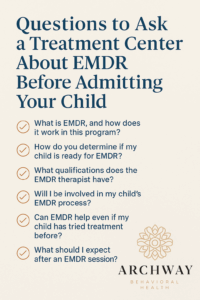
What Should I Expect After an EMDR Session?
EMDR can be surprisingly intense—even when it “works.” Some people feel lighter right away. Others feel drained, disoriented, or emotionally raw for a day or two.
That’s normal.
Ask the center:
- How do you support clients post-session?
- Are there grounding tools or check-ins?
- Can clients opt out if it feels too overwhelming?
You’re looking for aftercare. Not just for your child’s safety—but for their dignity. EMDR should never leave someone emotionally unguarded.
How Does EMDR Fit Into the Bigger Picture?
Even when EMDR is effective, it’s just one part of recovery. Your child still needs:
- Peer connection
- Emotional regulation skills
- Family boundaries and support
- Possibly psychiatric care
Ask about wraparound support:
- What other therapies are offered?
- How do staff help connect the dots between EMDR, recovery, and daily life?
- What happens if EMDR brings up memories my child wasn’t expecting?
At Archway, we treat EMDR as a doorway, not a destination. Our team surrounds each client with trauma-informed care—from stabilization to skill-building to long-term planning.
If you’re looking for EMDR in Boca Raton or surrounding areas like Coral Springs or Deerfield Beach, make sure the center you choose offers more than a buzzword. Look for real clinical integration.
FAQ: EMDR for Young Adults in Treatment
Q: How long does EMDR treatment usually take?
A: EMDR is not a one-time session. Some people feel shifts after a few meetings, while others work through multiple targets over weeks or months. It depends on the depth of trauma and emotional readiness.
Q: Can EMDR make things worse before they get better?
A: Sometimes, yes. EMDR can stir up emotions and memories that have been suppressed. But with proper support, this discomfort becomes part of healing—not retraumatization.
Q: Is EMDR only for people with PTSD?
A: No. EMDR can also help with anxiety, depression, low self-esteem, or complicated grief—especially when these stem from unresolved experiences.
Q: What if my child doesn’t want to do EMDR?
A: Consent matters. No therapy should be forced. A good center will offer education, encouragement, and alternative options—never pressure.
Q: How do I know if EMDR is working?
A: Progress isn’t always dramatic. You might notice small shifts: fewer emotional blowups, more reflective conversations, or a softer edge around old pain.
📞 Ready to Talk?
Call (888) 530-0227 or visit to learn more about our EMDR services in Boca Raton, Florida. We’re here to answer your questions—patiently, and without pressure.
