

Let’s be honest: IOP can feel like too much and not enough at the same time. You show up, you share, you try to stay open—but somewhere along the way, it starts to feel like homework. Like you’re being graded on your pain. If you’ve ghosted your intensive outpatient program, or thought about it, you’re not broken. You’re just human. And you’re not alone.
At Archway Behavioral Health’s intensive outpatient program in Boca Raton, Florida, we’ve seen what happens when people give themselves permission to come back. Not to “start over”—but to start differently.
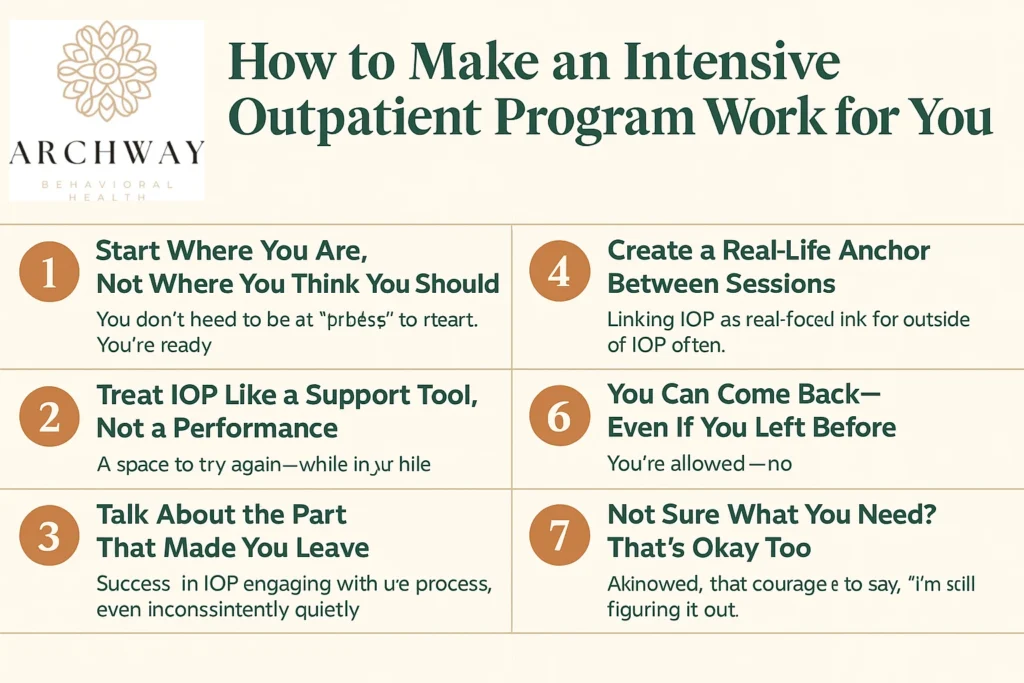
1. Start Where You Are, Not Where You Think You Should Be
You don’t have to be at your “best” to restart. You don’t even have to be ready—you just have to be willing. If you’re feeling ashamed of ghosting group or missing sessions, you’re not alone. And here’s the truth: your return is not a report card. It’s a restart button.
No one at Archway is counting your absences. We’re more interested in what you need now.
2. Treat IOP Like a Support Tool, Not a Performance
IOP isn’t about doing recovery “perfectly.” It’s about having a place where you can try again—while staying in your life. Some days, that might mean crying through the session. Other days, it’s just showing up with your camera off and a hoodie on.
It counts. All of it counts.
3. Talk About the Part That Made You Leave
There’s usually one moment—the comment that felt off, the assignment that triggered you, the group you couldn’t connect with. You don’t have to pretend it didn’t happen. In fact, naming it out loud might be the most healing thing you do.
Not sure how to bring it up? Try:
“Hey, I left because I felt ___ and didn’t know if it was safe to say it.”
Chances are, someone else in the room felt the same.
4. Redefine Success (Spoiler: It’s Not Just Attendance)
Success in IOP isn’t a perfect record. It’s engagement with your own process—messy, inconsistent, sometimes quiet. Progress might look like saying “pass” in group instead of ghosting completely. Or staying through a session even when you wanted to bolt.
You don’t have to be a “model client” to heal.
5. Create a Real-Life Anchor Between Sessions
If IOP feels like it lives in a bubble, it can get weirdly disconnected. Try linking what you’re learning to something real outside the room. Journal one takeaway. Text someone a boundary you practiced. Blast your session playlist on the drive home.
Bridging the gap makes it feel less like homework and more like your life getting sturdier.
6. You Can Come Back—Even If You Left Before
You’re allowed to walk back in the door. Even if you left. Even if you said you were done. Especially if part of you hopes it could feel different this time.
Whether you’re looking for an intensive outpatient program in Highland Beach, Florida or need a fresh start near Boca, the door’s still open.
You’re not too late. You’re just in the middle.
7. Not Sure What You Need? That’s Okay Too.
Sometimes the biggest reason people leave IOP is simple: they don’t know what they need, and that makes showing up feel pointless. But you don’t need a clear plan to be worthy of support. You just need a little courage to say, “I’m still figuring it out.”
That’s more than enough to start.
📞 Ready to try again, your way?
Call (888) 530-0227 or visit to learn more about our intensive outpatient program services in Boca Raton, Florida. Your next step doesn’t have to be perfect. It just has to be yours.